
Case study 4: Utilities & energy site (operational asset)
Project overview
A utility infrastructure operator engaged CDI Olfacta to assess a portfolio of operational sites across multiple locations including substation compounds, wayleave corridors and network access routes.
Routine vegetation management works had flagged suspected Japanese knotweed at several locations along network boundaries and access margins. The implications were immediate and significant:
• Regulatory obligations under invasive species legislation
• Risk of uncontrolled spread along linear network corridors
• Contractor exposure during scheduled vegetation clearance works
• Reputational and compliance risk for a regulated utility operator
The operator needed verified site-by-site risk intelligence before maintenance programmes resumed.
The challenge
Operational utility sites present a knotweed risk profile unlike any other asset class:
- Sites are geographically dispersed making consistent survey coverage difficult
- Access is restricted and often requires coordination with live network operations
- Vegetation clearance activities can inadvertently spread rhizome material if knotweed is present
- Regulatory obligations require documented evidence not just visual assessment
Standard survey approaches cannot deliver consistent verified results across a dispersed operational network.
Our approach
CDI Olfacta designed a repeatable detection programme that could be deployed across multiple sites without disrupting live operations.
1. Network risk profiling
- Review of site records, maintenance logs and historical vegetation reports across the portfolio
- Identification of highest-risk locations based on land use history and proximity to known knotweed populations
- Prioritisation of sites for phased inspection based on upcoming maintenance schedules
2. Coordinated site inspection
- Visual assessment conducted at each location in coordination with site safety requirements
- Assessment of boundary margins, access tracks, drainage channels and disturbed ground
- Consistent methodology applied across all sites to enable portfolio-level risk comparison
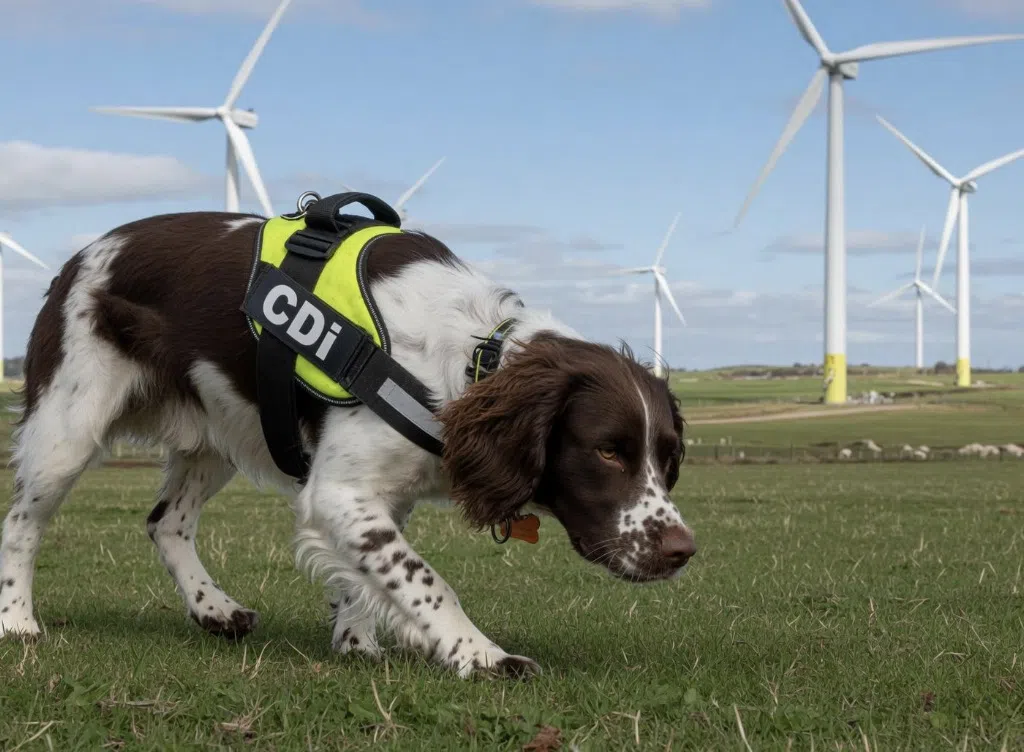
3. Canine detection deployment (full site sweep)
- Dogs deployed across all flagged locations and areas of restricted or limited visibility
- Particular focus on vegetation margins adjacent to live infrastructure and maintenance access routes
- Detection completed without disruption to live network operations
4. Targeted verification
- All canine alerts assessed and mapped with precise spatial reference
- Risk status confirmed at each location as active, dormant or clear
- Findings cross-referenced across the portfolio to identify patterns of spread
5. Asset management reporting
- Site-by-site risk register produced for integration into the operator’s asset management system
- Documentation structured to satisfy regulatory reporting requirements
- Findings aligned to the forward maintenance programme to sequence remediation efficiently
The findings
The inspection identified:
- Japanese knotweed confirmed at three sites within the portfolio
- Two further sites flagged for seasonal monitoring due to ground conditions at time of inspection
- The remaining sites confirmed clear allowing maintenance programmes to proceed without restriction
Canine detection delivered consistent and verified results across all locations regardless of access constraints or vegetation density.
The outcome
- Maintenance programmes resumed across confirmed clear sites without delay
- Remediation scoped and sequenced only for confirmed risk locations
- The operator established a verified baseline risk register across the full portfolio
- Regulatory obligations were met with documented evidence at every site
Commercial impact
Without verified early detection the operator faced:
- Blanket vegetation treatment across the full network at significant unnecessary cost
- Risk of inadvertent knotweed spread during unverified clearance works
- Regulatory exposure without documented site-by-site evidence
CDI Olfacta delivered:
- Precision – risk confirmed only at affected sites leaving the majority of the network clear
- Speed – full portfolio assessed efficiently around live operational constraints
- Cost control – targeted remediation replacing network-wide precautionary treatment
- Confidence – a verified risk register ready for regulators and asset managers
CDI
Smarter detection. Earlier Insight. Better Decisions.
Across Ireland, hidden risks undermine projects, budgets and long-term asset performance.
Corrosion and Japanese knotweed rarely reveal themselves early. They grow exponentially until damage is costly, hazardous, disruptive and increasingly difficult to control. Our specialist detection dogs identify risks at the earliest possible stage, giving you clarity long before traditional methods are able to confirm a problem.
Get in touch - we’re here to help.
If you’d like to discuss a project, have a question, request a presentation or CPD training for your team – don’t hesitate to let us know.