Case study 5: CUI detection using specialist canine
Project overview
A process plant operator engaged CDI Olfacta to carry out a CUI risk assessment across an aging section of insulated pipework at an operational facility in Ireland. The pipework network had been in service for over two decades and had not undergone full inspection since original installation.
Routine maintenance records and visual checks had flagged isolated areas of insulation damage and surface staining. The implications were immediate and significant:
• Risk of undetected corrosion progressing to structural failure
• Regulatory obligations around asset integrity and inspection records
• Cost of full insulation strip-out for traditional inspection running to six figures
• Operational disruption if plant sections required unplanned shutdown
The operator needed to identify where corrosion risk was real before committing to invasive inspection works.
The challenge
CUI is one of the most difficult integrity risks to manage on operational plant:
- Corrosion develops unseen beneath intact insulation with no surface indicators
- Traditional inspection requires insulation removal across entire suspect sections
- Full strip-out is costly, time consuming and disruptive to live operations
- Prioritising where to strip is guesswork without an accurate early detection method
Without a smarter detection approach the operator faced either unacceptable risk or unnecessary cost.
Our approach
CDI Olfacta deployed a scalable, high-accuracy detection strategy designed specifically for large sites.
1. Asset review and risk mapping
- Review of maintenance records, inspection history and previous integrity reports
- Identification of highest-risk pipework sections based on age, service history and insulation condition
- Prioritisation of inspection zones to focus canine resource where risk was greatest
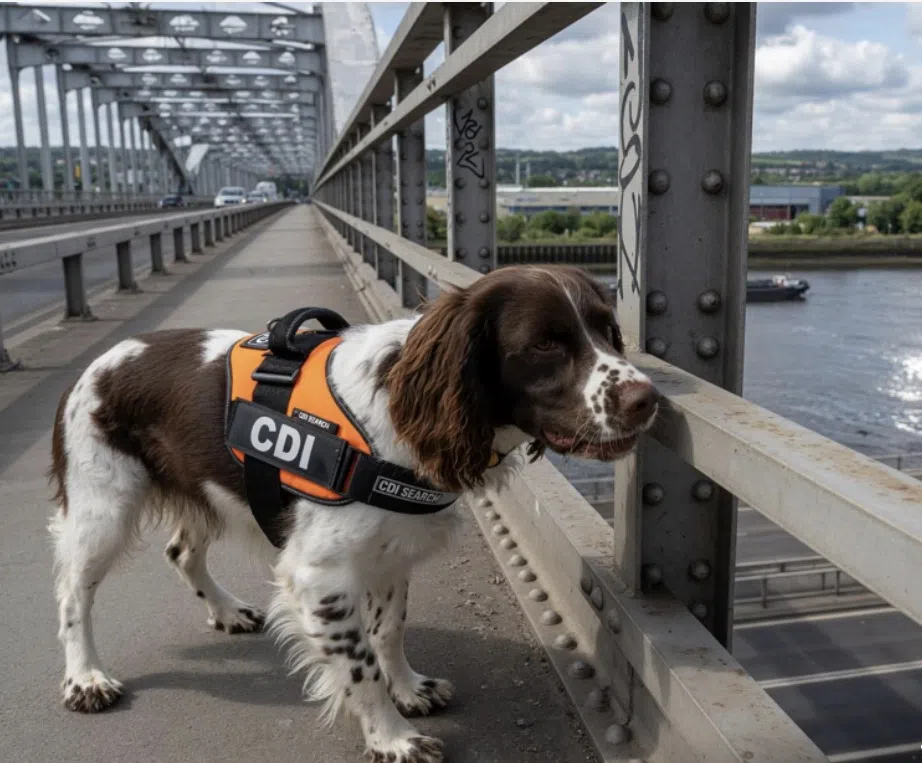
2. Non-intrusive canine sweep
- Specialist dogs deployed along prioritised pipework sections
- Detection carried out with no insulation removal and no disruption to live plant operations
- Full sweep completed within a single planned inspection window
3. Alert mapping and verification
- All canine alerts recorded with precise location reference along the pipework network
- Flagged sections cross-referenced against maintenance history and known risk factors
- Alert confidence levels documented to support prioritisation of intrusive follow-up
4. Targeted intrusive inspection
- Insulation removed only at confirmed alert locations
- Traditional inspection methods applied to verify canine findings
- Results compared against canine detection accuracy to validate the methodology
5. Integrity-ready reporting
- Findings documented in a format suitable for the operator’s asset integrity management system
- Recommendations structured around inspection priority and planned maintenance windows
- Evidence trail prepared to satisfy regulatory inspection requirements
The findings
The inspection identified:
- Active corrosion confirmed at four discrete locations across the pipework network
- Two further sections flagged as elevated risk for priority monitoring
- The majority of the network confirmed as low risk avoiding unnecessary strip-out
Canine detection accurately identified active corrosion in every confirmed location and produced no false positives across the verified sections.
The outcome
- Intrusive inspection was targeted only at confirmed risk locations
- Plant operations continued without unplanned shutdown or programme disruption
- The operator established a verified integrity baseline across the full pipework network
- Regulatory inspection obligations were met with a fully documented evidence trail
Commercial impact
Without canine-led detection the operator faced:
- Full insulation strip-out across all suspect sections at significant cost
- Extended plant downtime during unnecessary inspection works
- Risk of active corrosion going undetected until structural failure
CDI Olfacta delivered:
- Precision – corrosion confirmed only where it existed eliminating speculative strip-out
- Speed – full network assessed within a single planned inspection window
- Cost control – targeted intrusive works replacing costly blanket removal
- Confidence – a verified integrity record ready for regulators and asset managers
CDI
Smarter detection. Earlier insight. Better decisions.
Across Ireland, hidden risks undermine projects, budgets and long-term asset performance.
Corrosion and Japanese knotweed rarely reveal themselves early. They grow exponentially until damage is costly, hazardous, disruptive and increasingly difficult to control. Our specialist detection dogs identify risks at the earliest possible stage, giving you clarity long before traditional methods are able to confirm a problem.
Get in touch - we’re here to help.
If you’d like to discuss a project, have a question, request a presentation or CPD training for your team – don’t hesitate to let us know.