
Case Study 1: Japanese knotweed risk management on a major development site
Project overview
A national developer engaged CDI Olfacta during the pre-construction phase of a multi-unit residential development in Dublin, comprising over 80 units across a previously
undeveloped brownfield site.
During initial groundworks planning, historical records and neighbouring site reports
indicated a potential presence of Japanese knotweed along boundary lines and within
sections of the site.
The implications were immediate and significant:
• Programme delays ahead of mobilisation
• Increased due diligence requirements from funders
• Potential planning and environmental compliance risks
• Exposure to six-figure remediation costs
The developer needed certainty at speed—before committing to full site works.
The challenge
Large development sites present a unique knotweed risk profile:
• Vegetation often cleared or buried during previous use
• Rhizomes can remain dormant underground for years
• Spread may extend across boundaries into adjoining land
• Early-stage misidentification can lead to costly over- or under-reaction
Traditional site surveys alone could not provide the level of assurance required by
investors, planners and contractors.
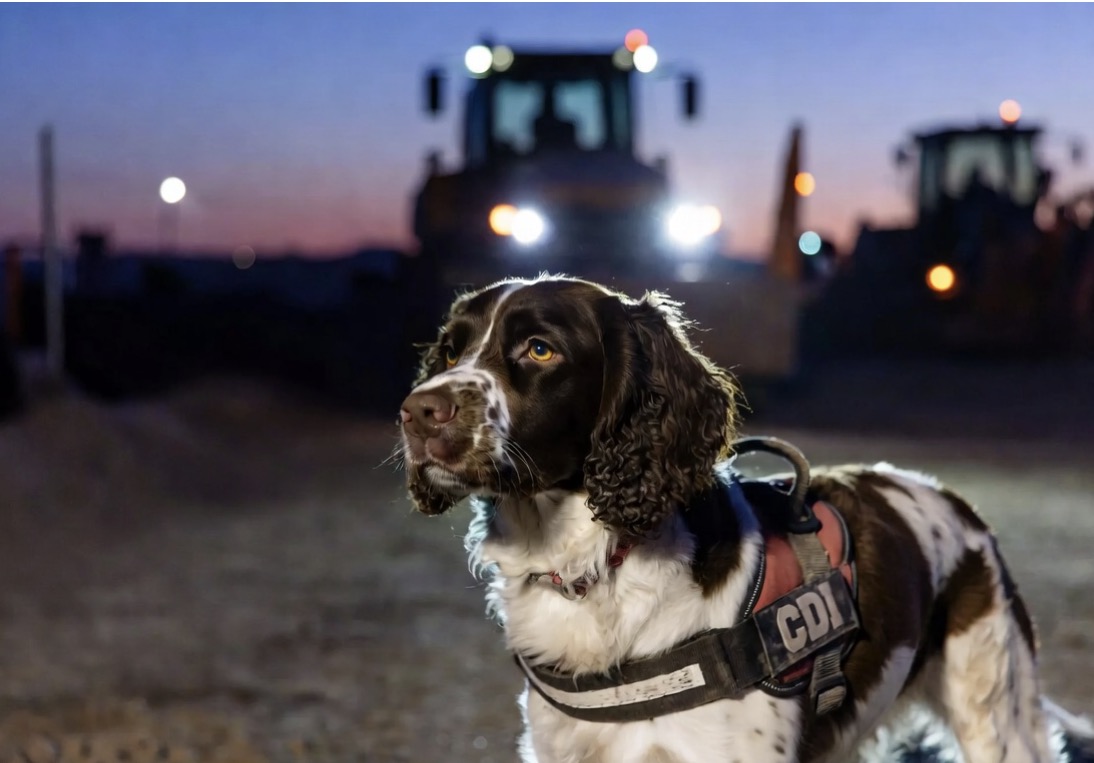
Our Approach
CDI Olfacta deployed a scalable, high-accuracy detection strategy designed specifically for large sites.
1. Site Iitelligence & risk mapping
- Review of historical land use and environmental reports
- Identification of high-risk zones (boundaries, disturbed ground, service corridors)
- Zoning the site for systematic inspection
2. Phased on-site inspection
- Detailed visual assessment across accessible areas
- Identification of regrowth indicators and suspect vegetation
- Prioritisation of zones requiring deeper investigation
3. canine detection deployment (full site sweep)
- Boundary perimeters
- Stockpiled soils and made ground
- Areas scheduled for immediate excavation
4. Targeted verification
- Correlation of canine alerts with ground conditions
- Pinpointing exact locations of confirmed risk
- Differentiation between active, dormant and absent zones
5. Developer-ready reporting
- Clear, mapped outputs showing risk zones
- Practical recommendations aligned to construction sequencing
- Documentation suitable for lenders, planners and environmental consultants
The findings
The inspection identified:
• Isolated pockets of Japanese knotweed along one boundary line
• Evidence of historic spread into a limited section of made ground
• Majority of the site confirmed clear, including all primary build zones
Crucially, the canine detection process eliminated uncertainty across the wider site, allowing the developer to avoid blanket remediation.
The outcome
- Construction programme proceeded without major delay
- Remediation was targeted, not site-wide, significantly reducing cost
- Developers maintained confidence with funders and stakeholders
- Risk was contained early—before it became a critical issue
Commercial impact
Without accurate early-stage detection, the developer faced:
- Full-site excavation or unnecessary remediation
- Programme delays impacting contractor schedules
- Increased scrutiny from investors and regulators
Instead, CDI Olfacta delivered:
- Precision – exact identification of affected areas
- Speed – rapid site-wide assessment
- Cost control – avoiding unnecessary works
- Confidence – clear, defensible evidence for decision-making
CDI
Smarter detection. Earlier insight. Better decisions.
Across Ireland, hidden risks undermine projects, budgets and long-term asset performance.
Corrosion and Japanese knotweed rarely reveal themselves early. They grow exponentially until damage is costly, hazardous, disruptive and increasingly difficult to control. Our specialist detection dogs identify risks at the earliest possible stage, giving you clarity long before traditional methods are able to confirm a problem.
Get in touch - we’re here to help.
If you’d like to discuss a project, have a question, request a presentation or CPD training for your team – don’t hesitate to let us know.