
Project overview
A national roads authority engaged CDI Olfacta during the pre-construction phase of a major road development corridor spanning multiple counties. The route passed through a range of land types including former agricultural land, disused industrial plots and roadside verges with a long history of unmanaged vegetation.
Early environmental screening flagged a credible risk of Japanese knotweed presence along significant portions of the corridor. The implications were immediate and significant:
• Programme delays ahead of statutory approvals
• Increased scrutiny from environmental regulators
• Potential legal exposure under invasive species legislation
• Risk of six-figure containment and disposal costs
The authority needed a clear picture of risk across the entire corridor before works could proceed.
The challenge
Linear infrastructure projects present a distinct knotweed risk profile:
- Corridor extends across multiple land ownerships and historical uses
- Vegetation disturbance during early site clearance can accelerate rhizome spread
- Cross-boundary spread creates legal liability between landowners and contractors
- Traditional survey methods are impractical and inconsistent at this scale
Standard walkover surveys could not deliver the speed, accuracy or legal defensibility required across a corridor of this size.
Our approach
Road development corridors shift with every phase of ground preparation. CDI Olfacta built a detection programme around that reality.
1. Site Iitelligence & risk mapping
- Historical land use reviewed across the full route length
- Former field boundaries, drainage lines and tipped areas flagged as priority zones
- Corridor divided into inspection segments based on risk profile
2. Phased on-site inspection
- Ground-level walkover conducted across each segment in sequence
- Vegetation patterns assessed for signs of historic or active knotweed presence
- Segments ranked to direct canine resource where it was needed most
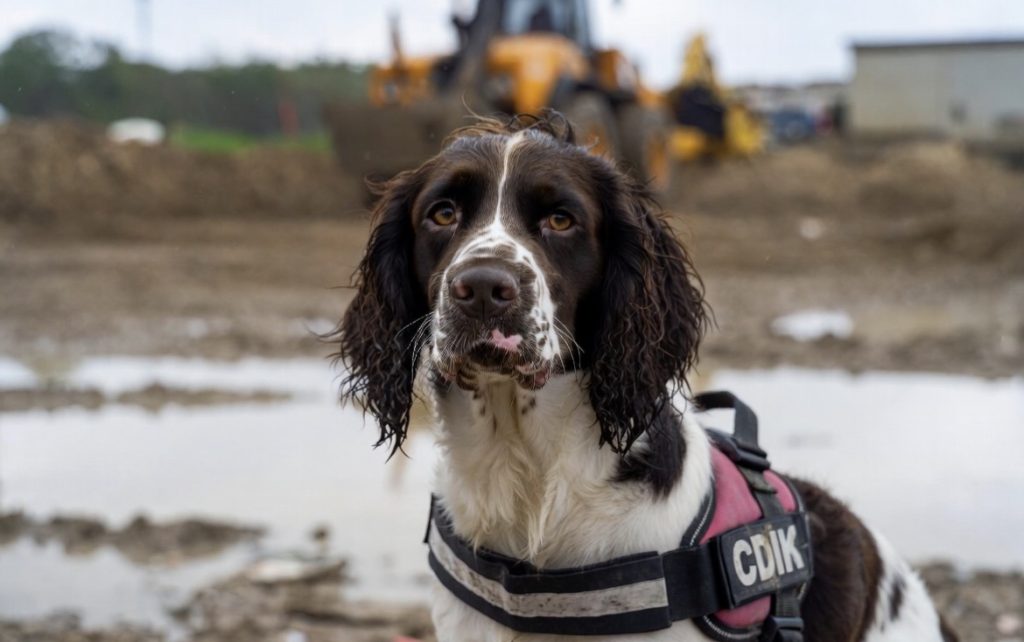
3. Canine detection deployment (full site sweep)
- Dogs deployed across all priority segments and disturbed ground
- Particular focus on areas of cut and fill, imported material and boundary margins
- Detection carried out ahead of any scheduled earthworks
4. Targeted verification
- Every canine alert followed up with ground assessment
- Risk zones mapped as active, dormant or clear
- Adjoining land assessed where boundary spread was suspected
5. Contractor-ready reporting
- Outputs structured around the construction programme and procurement timeline
- Documentation prepared to satisfy regulatory and legal requirements
- Findings presented in a format usable by site teams from day one
The findings
The inspection identified:
- Japanese knotweed confirmed in three discrete locations along the corridor
- Evidence of spread from adjoining land at two boundary points
- The vast majority of the route confirmed clear including all primary earthworks zones
Canine detection resolved uncertainty in sections where visual survey was inconclusive
The outcome
- Earthworks programme proceeded on schedule without environmental-driven delays
- Remediation was limited to confirmed zones only avoiding unnecessary treatment
- A clear evidence trail was maintained for regulatory compliance
- Risk was resolved before any contractor was on the ground
Commercial impact
Without early detection, the authority faced:
- Blanket treatment across unverified sections of the corridor
- Contractor delays and programme overrun
- Regulatory exposure under invasive species law
CDI Olfacta delivered:
- Precision – risk confirmed only where it existed
- Speed – full corridor assessed efficiently
- Cost control – targeted works replacing speculative treatment
- Confidence – evidence ready for regulators and funders
CDI
Smarter detection. Earlier insight. Better decisions.
Across Ireland, hidden risks undermine projects, budgets and long-term asset performance.
Corrosion and Japanese knotweed rarely reveal themselves early. They grow exponentially until damage is costly, hazardous, disruptive and increasingly difficult to control. Our specialist detection dogs identify risks at the earliest possible stage, giving you clarity long before traditional methods are able to confirm a problem.
Get in touch - we’re here to help.
If you’d like to discuss a project, have a question, request a presentation or CPD training for your team – don’t hesitate to let us know.