When Japanese knotweed is found or suspected on a property, many people immediately start thinking about treatment. That reaction is understandable. If the plant is visible, or if it has been raised during a property survey, site inspection or development review, the natural instinct is to ask how quickly it can be removed or controlled.
However, treatment is not always the first step. Before a treatment plan can be useful, the site needs to be properly understood. Where is the knotweed risk? Is it only visible above ground, or could there be concealed rhizomes below the surface? Has the plant spread into soil that may later be excavated, moved or built over? Is the concern limited to one visible stand, or could there be hidden growth elsewhere on the site?
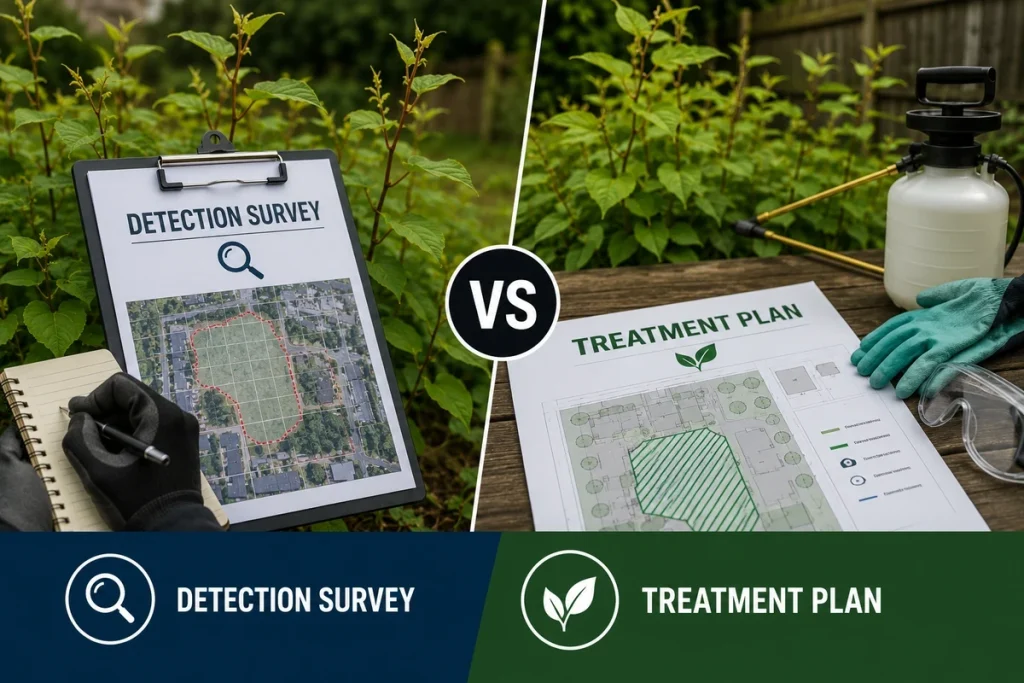
This is where a detection survey can become essential. A treatment plan tells you how Japanese knotweed may be managed. A detection survey helps confirm where the risk may be present before that plan is made. For homeowners, buyers, developers, contractors and commercial landowners in Ireland, getting this order wrong can lead to wasted money, missed rhizomes, unnecessary treatment, project delays or unexpected soil-management problems later.
In simple terms, detection should usually come before treatment planning when the full extent of Japanese knotweed risk is uncertain.
Why the order matters
The order matters because Japanese knotweed is not only a visible plant. The stems and leaves above ground may show where the plant is active, but they do not always show the full risk below the surface. The underground rhizome system can remain hidden, dormant or concealed, especially where the site has been cut back, disturbed, covered, landscaped or inspected outside the growing season.
A treatment plan based only on what can be seen may miss areas where rhizomes remain present. It may focus on the obvious stand while overlooking hidden material near boundaries, stockpiles, access routes, disturbed ground or proposed excavation zones. This can be a serious issue if the site is later developed, sold, landscaped or cleared.
For a homeowner, that could mean the problem returns after treatment appears to be working. For a seller, it could mean a buyer’s survey raises further questions. For a developer, it could mean knotweed is found after contractors have already started work. For a commercial landowner, it could mean treatment costs and programme risk were underestimated from the start.
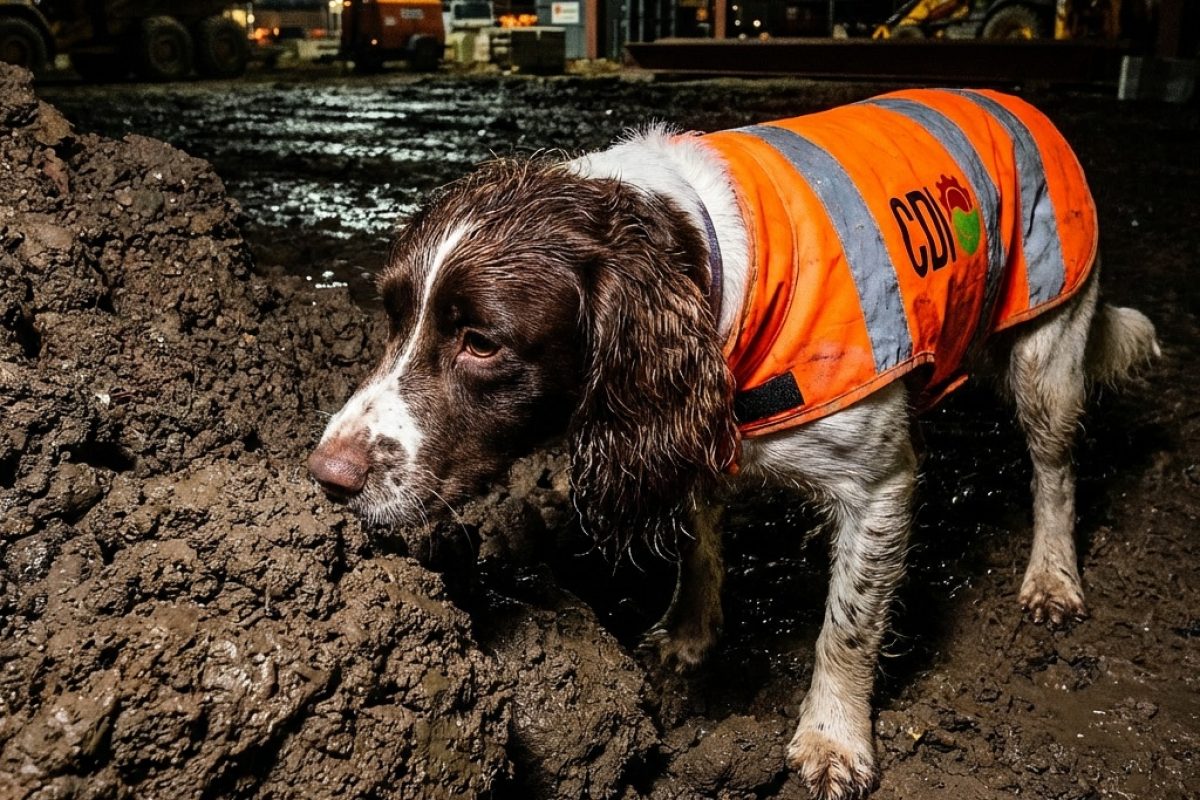
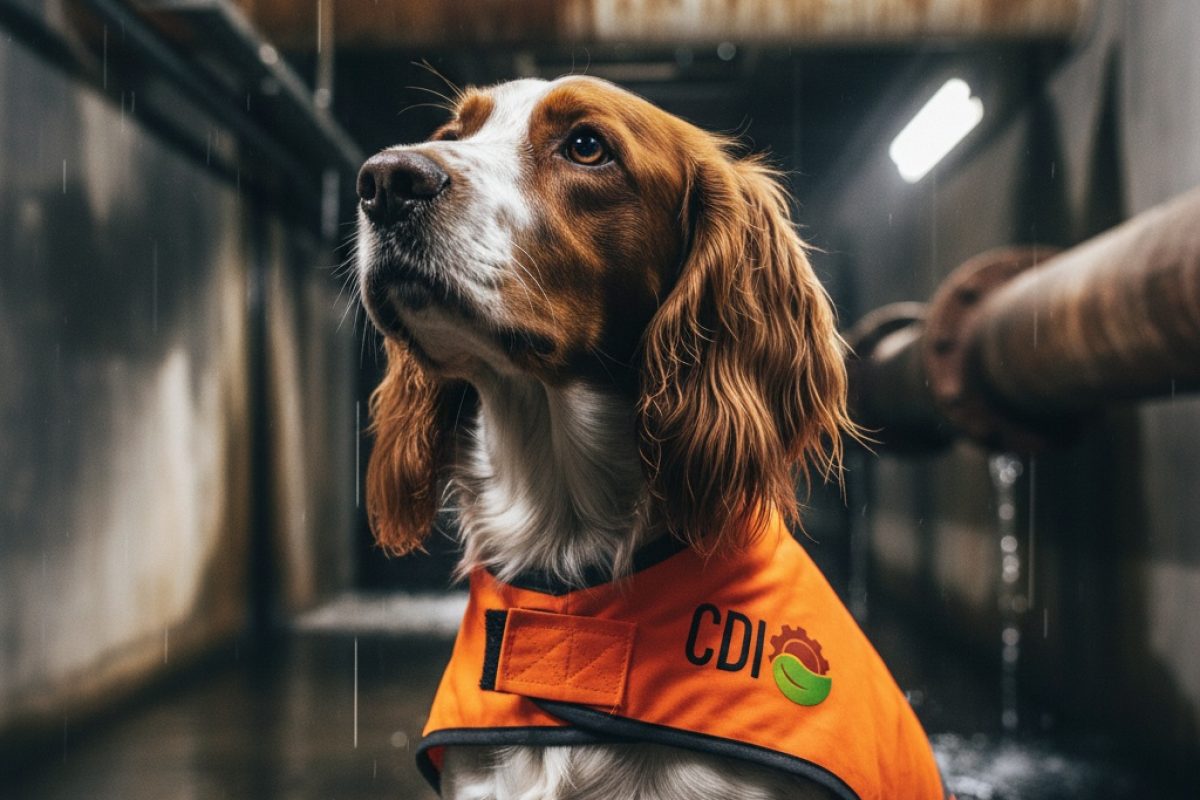
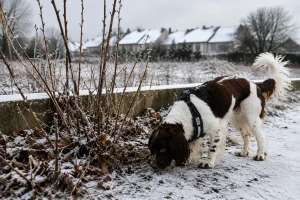
A detection survey helps reduce this uncertainty. CDI’s Japanese knotweed detection dogs are trained to identify the scent of Japanese knotweed, including underground, dormant or concealed growth. This can help identify risk that may not be obvious through visual inspection alone.
What is a Japanese knotweed detection survey?
A Japanese knotweed detection survey is used to help identify whether Japanese knotweed may be present on a site, including areas where visible growth is limited or absent. It is especially useful where decisions need to be made before treatment, purchase, sale, excavation, clearance or construction work.
The aim is not simply to look at the visible plant. The aim is to understand where hidden risk may exist so that the next step is based on better information. This can include checking areas where knotweed has previously been recorded, areas where suspicious growth has been cut back, boundaries where knotweed may be spreading from adjoining land, and zones where soil movement is planned.
A detection survey can also support decision-making where a previous inspection was inconclusive. For example, a visual survey may flag suspicious stems but not confirm the full extent. A buyer may be concerned about old canes near a boundary. A contractor may be unsure whether soil can be disturbed safely. A development team may need more confidence before finalising a programme or remediation budget.
In these situations, a Japanese knotweed survey gives the site owner or project team a clearer starting point. It does not replace every later specialist step, but it can make those steps more informed.
What is a Japanese knotweed treatment plan?
A Japanese knotweed treatment plan sets out how confirmed Japanese knotweed will be managed, controlled or remediated. Depending on the site, this may involve a herbicide programme, excavation, containment, removal, monitoring or a combination of approaches. The correct route depends on the extent of the infestation, the site use, the timescale, the level of disturbance planned and any regulatory or disposal requirements.
A treatment plan should be site-specific. Japanese knotweed on a quiet garden boundary is not the same as Japanese knotweed on a development site where foundations, drainage and access roads are planned. A patch on unmanaged land is not the same as rhizome risk inside soil that may be moved. The treatment approach must match the actual conditions and future plans for the land.
This is why treatment planning without accurate detection can be risky. If the plan is based on incomplete information, it may understate the problem or treat the wrong area. It may also fail to account for hidden rhizomes that could later be disturbed.
Invasives.ie advises that a good site-specific plan is important when dealing with Japanese knotweed and that professional advice should be sought because improper treatment can make the issue worse. A detection survey supports that planning stage by helping define where the risk may be before management decisions are made.
Which comes first: detection survey or treatment plan?
In most cases, a detection survey should come before a treatment plan when the extent of Japanese knotweed is uncertain.
If the plant is clearly visible and the affected area is simple, a treatment specialist may be able to assess the site and prepare a plan from the visible evidence and site history. However, many real sites are not simple. The knotweed may have been cut back. It may be dormant in winter. It may be growing from neighbouring land. It may have spread into soil. It may be hidden under vegetation, hardstanding, rubble or previously disturbed ground.
In those situations, moving straight to treatment can mean planning around only the obvious part of the problem. The visible growth becomes the focus, while concealed risk remains untested.
A detection survey helps answer the earlier question: where might Japanese knotweed be present? Once that question is better understood, the treatment plan can be more accurate, targeted and practical.
This is especially important before excavation, construction, sale, purchase or commercial land due diligence. If money is going to be spent on treatment or remediation, the first priority should be understanding what needs to be treated.
Why treatment without detection can become expensive
Treatment without proper detection can become expensive because the wrong assumptions may shape the whole plan.
One common mistake is assuming the visible stand represents the full extent of the issue. Japanese knotweed may appear in one obvious area, while underground rhizome material extends beyond it. If only the visible area is treated, the site owner may later find regrowth in places they thought were clear.
Another risk is treating too broadly because the site team does not know where the real risk sits. Without better detection, a landowner may overestimate the affected area and spend money managing sections of the site that may not require the same level of attention. On larger commercial or development sites, that can increase cost and complexity unnecessarily.
There is also the problem of timing. If detection is skipped before groundworks, the issue may be discovered after contractors have mobilised. At that point, the cost is not only treatment. The project may face delay, rescheduling, temporary exclusion zones, further investigation, soil handling changes and additional professional input.
For sites where excavation or soil movement is planned, CDI’s guidance on contaminated soil movement is particularly relevant. Once contaminated material is moved, the problem can become more complicated than it was at the start.
Detection before treatment for homeowners
For homeowners, the question often starts with fear. If Japanese knotweed is seen in a garden, near a boundary or close to a neighbouring property, it can feel urgent. Many people want immediate treatment because they worry about property value, mortgage issues, sale delays or future spread.
Treatment may be needed, but the first step should be understanding the risk properly.
If the knotweed is visible in one part of the garden, a detection survey can help check whether the concern may extend beyond the obvious area. If the plant appears near a boundary, detection can help assess whether there may be risk on the homeowner’s side or from adjoining land. If the property is being sold, clearer information can help reduce uncertainty before buyers or surveyors raise questions.
A detection survey can also be useful where the homeowner is not sure whether the plant is still active. Japanese knotweed may have been cut down, sprayed previously or died back in winter. In these situations, visible signs may not tell the full story.
Before committing to a treatment plan, homeowners benefit from knowing what they are dealing with. A better understanding of the site can lead to better advice, more realistic expectations and fewer surprises later.
Detection before treatment for buyers and sellers
Property transactions can become more difficult when Japanese knotweed is confirmed or suspected. A buyer may worry about future costs. A seller may worry about the sale falling through. A solicitor may ask for more information. A surveyor may flag suspicious growth but not provide full clarity.
In these situations, a treatment plan may eventually be required, but detection can still come first when the extent of the risk is unclear.
For buyers, detection can help answer whether the property itself may be affected and whether further advice is needed before committing. For sellers, detection can provide useful information before negotiations become more difficult. It may help show that the concern has been checked responsibly, rather than leaving the issue open to assumption.
This links closely with CDI’s article on property survey issues, where knotweed concerns can affect confidence and create additional steps during a transaction.
The goal is not to turn every property concern into a major problem. The goal is to replace uncertainty with better information so that the right next step can be taken.
Detection before treatment for developers
For developers, detection before treatment planning is often critical. A development site may involve excavation, clearance, stockpiling, drainage, foundations, access works and service installation. If Japanese knotweed risk is not properly understood before those activities begin, the issue can affect the whole programme.
A visible patch on one part of the site may not show the full underground extent. Historic disturbance may have moved material. Old stockpiles may contain viable fragments. Boundary growth may have spread into the development area. Previous clearance may have removed visible signs without removing the underground risk.
If a treatment plan is prepared without that wider understanding, it may not protect the project from later disruption.
Detection can help developers and consultants identify risk earlier, before contractors are fully committed and before soil is moved. It can also support more accurate communication with treatment specialists, environmental consultants, funders and project teams.
CDI’s article on construction site knotweed explains why early identification matters before groundworks. The same principle applies here. Treatment planning is stronger when detection has already helped define the likely risk areas.
Detection before treatment for commercial land
Commercial land can carry knotweed risk that is not obvious during a standard viewing or desk review. A site may have overgrown boundaries, old industrial surfaces, rough ground, previous clearance, stockpiles, hidden corners or neighbouring land with invasive plant issues.
If a buyer or investor moves straight to pricing treatment without detection, they may not understand the full liability. The treatment quote may be based on incomplete evidence. The risk may be understated, or the cost may be overestimated because no one is sure where the knotweed may actually be present.
A detection survey before treatment planning can help commercial buyers and landowners make better decisions. It can support acquisition discussions, redevelopment planning, lender confidence and risk allocation between parties.
For a commercial site, the value of detection is often much greater than the survey itself. It can influence whether the site is viable, whether a treatment plan is realistic, whether excavation assumptions need to change and whether additional due diligence is needed before purchase.
What a sensible workflow looks like
A sensible workflow starts with risk recognition. Japanese knotweed may be visible, suspected, reported by a surveyor, raised by a neighbour, found in old site records or identified during pre-construction checks.
The next step is not automatically treatment. The next step is to understand the site. Where is the suspected knotweed? Is there visible growth? Has it been cut back or treated before? Is the site being bought, sold, developed or excavated? Could soil movement be involved? Are there boundary or neighbouring land concerns?
Once these questions are understood, a detection survey can help identify whether hidden or concealed knotweed risk may be present. The findings can then guide the next professional step, which may include treatment planning, remediation advice, monitoring, further investigation or changes to site activity.
This sequence helps avoid rushing into action without enough information. It also helps prevent treatment from being planned around only the most visible part of the problem.
For CDI clients, the purpose of detection is clarity. It gives homeowners, developers and landowners a better basis for deciding what to do next.
Detection is not a replacement for treatment
It is important to be clear that detection and treatment are not the same thing.
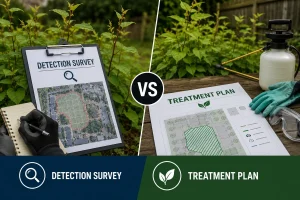
A detection survey helps identify whether Japanese knotweed may be present and where further attention may be needed. A treatment plan sets out how confirmed knotweed should be controlled or remediated. Both can be important, but they answer different questions.
Detection answers the question: where is the risk?
Treatment planning answers the question: how should the confirmed risk be managed?
When people confuse these two steps, they can either expect detection to solve the problem or expect treatment to work without proper site understanding. The better approach is to see them as connected stages.
Detection gives treatment planning a stronger foundation. Treatment gives the site a management route once the risk is properly understood.
When treatment may come first
There are some situations where treatment planning may begin quickly, especially where Japanese knotweed is clearly visible, the affected area is straightforward and there is no planned disturbance. A specialist treatment provider may inspect the visible growth, consider the site context and recommend a control programme.
However, even in these cases, detection may still be useful if there are questions about hidden spread, boundaries, previous clearance, winter dieback or soil movement.
The more complex the site, the more important detection becomes. A small garden patch that will not be disturbed is different from a development site with groundworks. A clearly visible stand is different from a suspected infestation that has been cut back. A simple treatment area is different from commercial land being assessed before purchase.
The decision is not about choosing detection or treatment. It is about choosing the right sequence for the risk.
Why CDI should be involved early
CDI should be involved early because the most expensive Japanese knotweed problems often begin with uncertainty. The plant is suspected but not confirmed. A site looks clear but has a history of knotweed. A buyer is concerned but the seller has limited information. A developer is preparing to start works but does not know whether hidden rhizomes may be present.
These are the moments where early detection can protect decision-making.
CDI’s detection dogs are trained to identify hidden, underground or dormant Japanese knotweed risk that may not be visible during a traditional inspection. This makes the service particularly useful before treatment planning, excavation, site clearance, property purchase or commercial land due diligence.
Early detection can help reduce the chance of paying for the wrong solution, missing hidden risk or discovering the issue after more expensive decisions have already been made.
If Japanese knotweed is known, suspected or uncertain, the best time to arrange detection is before the site is disturbed and before treatment decisions are finalised.
Final thoughts
A Japanese knotweed treatment plan is important, but it should be based on a clear understanding of the site. If the full extent of the risk is uncertain, a detection survey should usually come first.
This is especially true when the plant may be hidden, dormant, cut back, close to a boundary, present in soil or located on land that will be bought, sold, excavated or developed. Treatment without detection can lead to missed rhizomes, poor planning, unnecessary costs and delays.
A detection survey helps answer the question that matters before treatment begins: where is the Japanese knotweed risk?
Once that is clearer, the next steps can be planned with more confidence.
If you are considering treatment, remediation, excavation or a property decision involving Japanese knotweed, contact CDI before taking action. A professional detection survey can help you understand the risk before committing to a treatment plan.
FAQs
Do I need a detection survey before Japanese knotweed treatment?
You may need a detection survey before treatment if the full extent of the knotweed risk is uncertain. This is especially important where the plant may be hidden, dormant, cut back, near a boundary or present in soil that could be disturbed.
Is a treatment plan the same as a detection survey?
No. A detection survey helps identify where Japanese knotweed risk may be present. A treatment plan explains how confirmed Japanese knotweed should be managed or controlled. They are connected, but they are not the same service.
Can Japanese knotweed treatment fail if detection is skipped?
Treatment can be less effective if hidden rhizomes or affected areas are missed. A treatment plan based only on visible growth may not account for concealed or underground risk.
Should developers arrange detection before remediation?
Yes, developers should strongly consider detection before remediation or groundworks where Japanese knotweed is known or suspected. Early detection can help reduce delays, support better planning and prevent soil movement problems.
Can I start digging after treatment begins?
You should not disturb soil affected by Japanese knotweed without proper professional advice. Excavation or soil movement can spread viable material if the risk has not been correctly assessed and managed.
What if Japanese knotweed was treated before but has no visible regrowth?
A lack of visible regrowth does not always prove that the underground rhizome system is no longer viable. A detection survey may be useful if the land will be sold, developed, excavated or disturbed.
When is the best time to arrange detection?
The best time to arrange detection is before treatment decisions, site clearance, excavation, property purchase or development work. Early detection provides better information before costly commitments are made.
Who should arrange a detection survey?
Homeowners, buyers, sellers, developers, contractors, commercial landowners and consultants should consider a detection survey when Japanese knotweed is known, suspected or uncertain and important decisions depend on the result.