Corrosion under insulation (CUI) is one of the most challenging forms of deterioration to manage in industrial facilities because damage can develop beneath insulation long before there are visible signs of a problem. For asset managers, maintenance engineers and integrity teams, the difficulty is not simply detecting corrosion but deciding which assets should be inspected first, where detailed investigations are most necessary and how to reduce the operational disruption associated with conventional inspection programmes. Removing insulation from extensive pipework and equipment can be expensive, labour-intensive and disruptive, particularly when facilities operate continuously or when access requires scaffolding and specialised arrangements. However, postponing inspections or concentrating on the wrong locations can leave significant corrosion risks unidentified. Risk-based CUI inspection offers a more structured approach by using information about equipment condition, operating environments, historical performance and the consequences of failure to prioritise inspection activities. When supported by suitable screening technologies, including specialist canine corrosion detection, this approach can help engineering teams focus their resources on areas that warrant closer attention while maintaining appropriate asset integrity and safety standards.
What is risk-based CUI inspection?
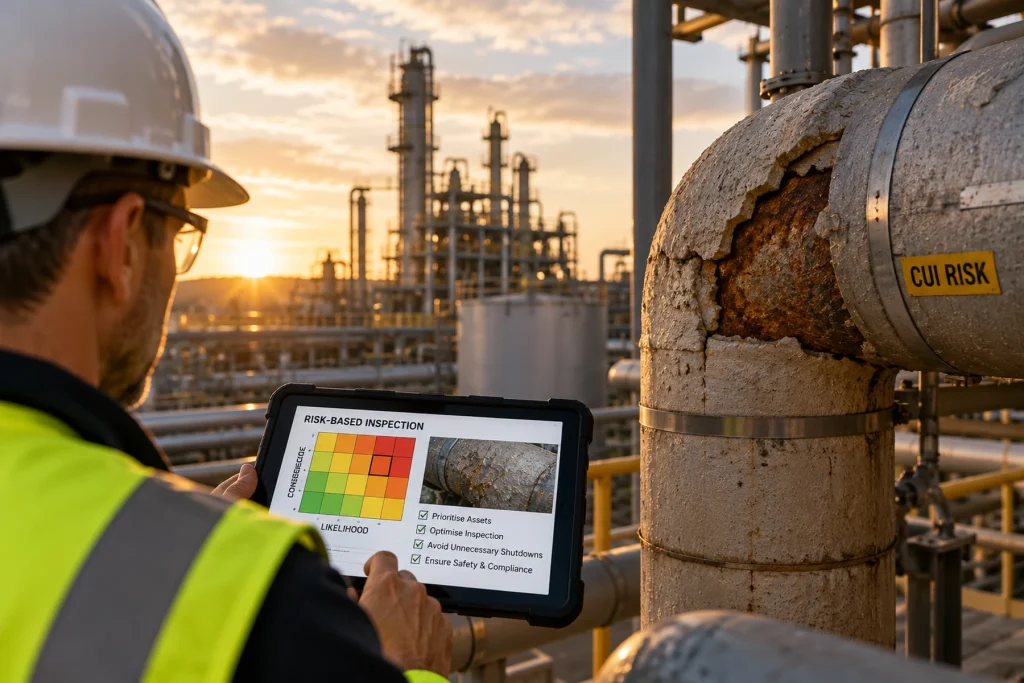
Risk-based CUI inspection is an approach to assessing and prioritising corrosion under insulation risks according to the likelihood of deterioration and the potential consequences of equipment failure. Instead of inspecting every insulated component in the same way or relying exclusively on fixed inspection intervals, asset integrity teams evaluate relevant risk factors to determine where inspection resources should be concentrated.
This approach recognises that not all insulated assets experience the same conditions or present the same level of risk. Two sections of pipework may have similar dimensions and insulation systems but operate under different temperatures, environmental conditions or maintenance histories. One section may contain damaged insulation, repeated moisture exposure or previous corrosion findings, while another may have a well-maintained weather barrier and no known history of deterioration.
The consequences of failure may also differ substantially. A component containing hazardous process material could present significant safety and environmental risks, whereas another component operating under less demanding conditions might have a lower consequence of failure. Both assets require appropriate integrity management, but they may not warrant identical inspection strategies.
Risk-based inspection, commonly referred to as RBI, provides a structured framework for considering these differences. Industry guidance such as API RP 580 and API RP 581 addresses the development and application of risk-based inspection programmes, while DNV-RP-G109 provides guidance specifically focused on risk-based management of corrosion under insulation.
For asset managers, the objective is to use relevant evidence to make defensible inspection decisions. A well-developed programme should improve understanding of asset condition, identify important deterioration mechanisms and direct suitable inspection methods toward the locations where they can provide the greatest value.
Why is corrosion under insulation difficult to manage?
Corrosion under insulation occurs when conditions beneath an insulation system allow deterioration to develop on the underlying metal surface. In many industrial environments, moisture can enter through damaged jacketing, poorly sealed penetrations, insulation terminations or other vulnerable locations. When water reaches the metal surface and remains trapped within the insulation system, corrosion may develop without being visible during routine external observations.
The challenge is that insulation often conceals the very surface that engineers need to examine. An apparently intact outer covering does not necessarily confirm that the underlying metal is free from corrosion. Conversely, visible damage to an insulation system does not automatically establish that substantial metal loss has occurred. The relationship between external appearance and actual deterioration can therefore be uncertain.
Operating conditions add another layer of complexity. Temperature cycles, intermittent operation, condensation, environmental exposure and changes in equipment use can influence the conditions under which CUI develops. Assets near coastal environments or exposed to repeated rain and moisture may face different challenges from equipment installed within sheltered facilities.
Inspection becomes more complicated when the affected equipment forms part of a live process. Removing insulation may require scaffolding, access permits, weather protection and reinstatement work. Certain inspection activities may also involve operational restrictions or additional safety controls, depending on the equipment and the techniques used.
These practical difficulties help explain why CUI can remain undetected for extended periods. Facilities may contain hundreds or thousands of potential inspection locations, making it unrealistic or uneconomical to expose every insulated surface during every maintenance cycle.
CDI’s guide to corrosion under insulation detection explains the underlying detection challenges and why investigating concealed corrosion requires methods suited to the condition of the assets.
Why traditional inspection schedules may overlook important CUI risks
Traditional inspection programmes commonly use periodic schedules, previous inspection intervals and established maintenance routines to determine when particular equipment should be examined. These methods can provide valuable structure and remain necessary where inspection codes, regulations or operating requirements establish specific obligations.
However, a schedule based primarily on elapsed time may not always reflect the actual distribution of corrosion risk across an industrial facility. Equipment installed during the same project may subsequently experience different moisture exposure, insulation damage, operational changes and maintenance conditions.
For example, a pipe section with damaged weatherproofing near an exposed support may experience repeated moisture ingress, while a neighbouring section with intact insulation remains comparatively protected. Inspecting both locations at the same frequency without considering their individual conditions may not direct sufficient attention toward the more vulnerable area.
Another limitation is the reliance on selected inspection points. Where extensive insulated pipework is involved, engineering teams may examine representative locations rather than expose the entire system. This can be appropriate within a properly designed inspection programme, but poorly selected points may fail to identify localised deterioration.
The problem becomes more significant when previous findings are not incorporated into future inspection planning. If corrosion is repeatedly identified around similar equipment features, those observations should influence how comparable locations are assessed.
Risk-based inspection does not eliminate the need for periodic checks or established inspection requirements. Instead, it provides a method of incorporating relevant risk information into decisions about inspection priorities, techniques and timing.
The objective is to avoid treating every component as though it presents an identical risk while ensuring that high-consequence equipment receives the attention required to maintain safe operation.
How does risk-based CUI inspection prioritise industrial assets?
A risk-based approach begins by identifying the assets under consideration and evaluating the factors that influence both the likelihood of deterioration and the consequences of failure. The resulting information helps determine which components should receive priority for inspection and which methods are suitable for further assessment.
The process should be based on available engineering records, operating information, inspection findings and relevant site observations. Where information is incomplete, the uncertainty itself may influence the assessment and justify additional investigation.
Probability of failure and corrosion susceptibility
The probability of failure is influenced by several considerations, including the likelihood of deterioration occurring and the potential progression of damage over time. In the context of CUI, relevant factors may include operating temperature, insulation condition, material characteristics, moisture exposure and previous corrosion findings.
Temperature is important because it can influence whether moisture remains present beneath insulation and how the corrosion process develops. Intermittent operating conditions and repeated temperature cycles can create additional complexity, particularly where moisture enters the insulation system.
The physical condition of insulation and protective coatings also matters. Damaged cladding, failed seals or compromised coatings may increase exposure to conditions that support corrosion. However, the presence of these indicators does not automatically establish the extent of metal loss.
Historical inspection results provide another source of evidence. Where similar equipment has repeatedly shown deterioration, engineering teams may consider whether comparable components share the same exposure conditions and potential damage mechanisms.
A formal risk assessment should use an appropriate methodology rather than assigning arbitrary risk scores based solely on appearance. The purpose is to develop a reasoned understanding of where deterioration could become significant.
Consequences of equipment failure
The consequences of failure are equally important when determining inspection priorities. A component may have only moderate evidence of increased corrosion susceptibility but still require early attention if failure could cause serious harm.
Potential consequences include personnel safety hazards, environmental releases, production losses, damage to surrounding equipment and interruption of essential services. The significance of these outcomes depends on the nature of the asset and the materials or processes involved.
For example, loss of containment from pressurised process equipment may create risks that extend beyond the immediate cost of replacing the affected component. The resulting consequences could involve emergency response, environmental management and substantial operational disruption.
Risk-based inspection therefore considers more than the probability that corrosion may be present. It also addresses what could happen if deterioration progresses to a critical condition.
This distinction helps prevent an inspection programme from focusing exclusively on the most visibly damaged insulation while overlooking components where a lower-probability event could have serious consequences.
Asset condition and inspection history
Reliable asset records are essential for effective CUI prioritisation. Information about installation dates, insulation specifications, previous repairs, operating changes and historical inspection findings can help explain why particular equipment may require closer attention.
However, industrial facilities do not always have complete records. Older installations may have undergone modifications without consistent documentation, and previous inspection findings may be stored across several maintenance systems.
Where information is missing, engineering teams should identify the uncertainty rather than assume that the absence of recorded corrosion means an asset is in good condition.
Inspection history should also be interpreted carefully. A previous inspection showing no significant corrosion provides useful evidence, but it does not guarantee that deterioration cannot develop later, particularly if insulation condition or operating circumstances have changed.
By combining historical information with current observations and appropriate screening, asset managers can develop a more useful picture of the areas where further investigation may be needed.
Which industrial assets should receive priority for CUI inspection?
The selection of high-priority assets should reflect the facility’s actual risk profile rather than a universal list of components that always require inspection first. However, certain conditions and equipment features frequently deserve closer attention because they can increase the likelihood of moisture ingress, conceal deterioration or complicate inspection access.
Insulated pipework is a common concern, particularly where systems contain numerous supports, penetrations, valves, flanges and changes in insulation geometry. These locations may create opportunities for water to enter or accumulate when weatherproofing and sealing arrangements deteriorate.
Equipment operating intermittently can also require careful assessment. Repeated heating and cooling may affect moisture behaviour within insulation systems, while changing service conditions can influence corrosion susceptibility over time.
Assets exposed to heavy rainfall, coastal conditions or other sources of environmental moisture may warrant additional consideration. The relationship between exposure and actual deterioration depends on insulation condition, protective systems and other site-specific factors.
Older installations may present challenges because insulation systems, coatings and maintenance records can vary considerably. However, equipment age alone should not determine inspection priority. A relatively new installation with damaged weatherproofing may require closer investigation than an older system maintained in suitable condition.
The consequences of equipment failure must remain central to the assessment. Components associated with hazardous substances, critical production processes or essential infrastructure may require additional scrutiny even when visible indicators of CUI are limited.
CDI discusses these considerations in its article on high-risk CUI inspection locations, including the importance of selecting inspection points according to site conditions rather than relying on arbitrary spacing.
How can risk-based inspection reduce unnecessary shutdowns?
One of the main operational advantages of risk-based inspection is the opportunity to plan investigative work more efficiently. When asset teams understand which components present the greatest concern, they can select appropriate inspection methods and coordinate maintenance activities around the facility’s operational requirements.
This does not mean that all high-risk equipment can be inspected safely while operating or that shutdowns are never necessary. Some inspections, repairs and verification activities require equipment to be isolated, depressurised or removed from service. Those decisions must be made through suitable engineering and safety assessments.
However, not every stage of corrosion investigation necessarily requires extensive insulation removal or plant shutdown. Certain screening techniques can help identify areas that deserve more detailed examination, allowing teams to avoid immediately exposing every insulated surface.
Where non-invasive screening is suitable, initial investigation may take place with less disruption than conventional strip-and-look inspection. Subsequent intrusive inspection can then be planned around the identified concerns and coordinated with maintenance opportunities.
For example, an asset manager responsible for a large network of insulated pipework may use available records and appropriate screening to identify areas requiring further verification. This can help determine which components should be inspected during the next planned maintenance window and which locations may require more urgent attention.
The benefit is not simply reducing inspection activity. It is improving the relationship between inspection effort, asset risk and operational planning.
A well-developed programme can also reduce unnecessary scaffolding and insulation reinstatement where suitable screening methods help narrow the locations requiring intrusive investigation. Actual savings depend on the facility, the technologies used and the results obtained.
What role can non-invasive detection play in CUI inspection planning?
Non-invasive and minimally invasive inspection technologies can support risk-based CUI programmes by helping engineering teams gather information before committing to more extensive physical access or insulation removal.
Traditional visual inspection remains important for identifying obvious defects, damaged weatherproofing and other external indicators. However, visual observations alone may not reveal corrosion developing beneath insulation.
Other inspection technologies can provide additional information. Depending on the application, methods such as radiography, guided wave ultrasonic testing and other suitable nondestructive testing techniques may assist with screening or assessing insulated equipment.
The capabilities and limitations of each method differ. Some technologies require local access, particular equipment geometries or specific operating conditions. Others are better suited to screening than to quantifying remaining wall thickness.
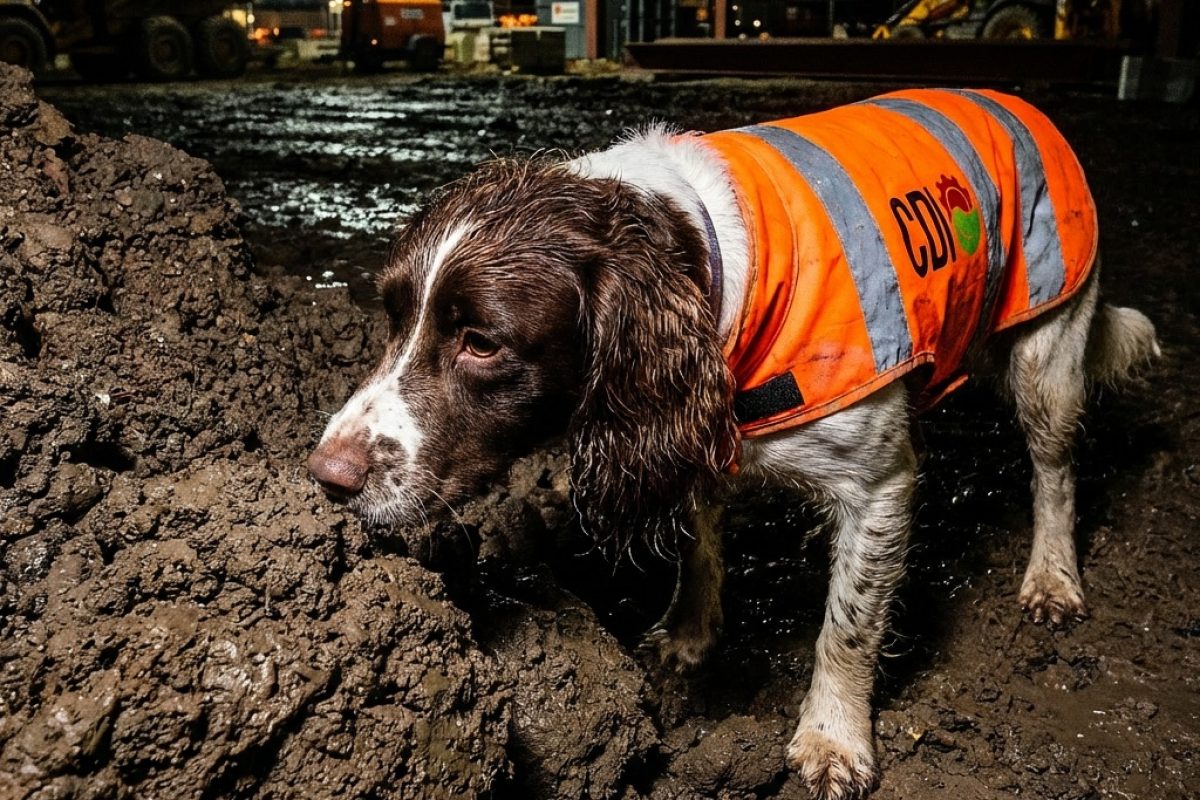
Specialist canine corrosion detection offers another approach. Trained detection dogs investigate volatile compounds associated with corrosion activity, helping identify potential areas of concern without routinely removing insulation during the initial screening process.
CDI provides early canine corrosion detection for industrial assets, with the objective of identifying areas that may warrant targeted follow-up investigation.
Canine detection should be understood as a screening method rather than a replacement for engineering inspection or measurements of remaining material thickness. A detection indication cannot independently establish the severity of corrosion, the remaining integrity of a component or whether continued operation is safe.
Its potential value lies in providing additional information that can help engineering teams decide where established verification methods should be applied.
How can canine corrosion detection support risk-based inspection?
Canine corrosion detection can support a risk-based inspection strategy by adding another source of information about locations where corrosion activity may be occurring. Rather than treating detection results as a standalone integrity assessment, engineering teams can incorporate them into wider decisions about inspection priorities.
Screening concealed corrosion without routine insulation removal
One of the practical challenges in CUI inspection is accessing the metal surface beneath insulation. Conventional inspection may require insulation to be opened at selected locations, followed by appropriate examination and reinstatement.
For extensive assets, this process can involve substantial labour and access costs. It can also create additional work where the exposed surfaces do not show the expected level of deterioration.
Specialist detection dogs offer a non-invasive screening approach that can investigate potential corrosion activity without routinely removing insulation during the initial survey. This may be useful when engineering teams need to assess large groups of insulated components before selecting locations for more detailed examination.
However, detection performance depends on factors such as the asset configuration, environmental conditions, accessibility and the nature of the target compounds. These considerations should be included in the survey planning and interpretation of results.
Identifying areas for targeted verification
Where a canine survey identifies potential corrosion activity, the relevant locations can be recorded for engineering review. The next step may involve targeted insulation removal, suitable NDT or another verification method selected according to the component and the questions that need to be answered.
This approach can help reduce uncertainty about where additional inspection resources should be directed. It also allows the engineering team to compare detection findings with existing risk rankings, insulation condition and previous inspection results.
Importantly, a lack of canine indication should not automatically justify extending inspection intervals or removing mandatory verification requirements. A negative screening result must be interpreted within the limitations of the method and the wider asset integrity programme.
The inspection plan should continue to reflect the assessed probability and consequences of failure, applicable requirements and the professional judgement of responsible engineers.
Supporting inspection planning at operational facilities
Operational facilities frequently face competing demands involving production, maintenance, safety and resource availability. A screening method that can be planned around normal site activities may help asset managers gather additional information before major maintenance work is scheduled.
Canine surveys may be suitable for selected operating environments, subject to appropriate access arrangements, safety assessments and site conditions. The non-invasive nature of the method can reduce the need for immediate insulation removal during screening, although it does not eliminate all access or operational constraints.
When used appropriately, detection findings can contribute to maintenance planning by helping identify locations where follow-up work should be considered.
This can be especially valuable where extensive insulated assets must be managed within limited inspection budgets, but decisions about repair, continued operation and shutdown requirements must always remain with qualified engineering personnel.
How does canine detection compare with traditional CUI inspection methods?
Conventional engineering inspection and canine corrosion detection serve different but potentially complementary purposes. Established NDT techniques are essential when engineers need to quantify metal condition, evaluate defects or determine whether equipment satisfies applicable integrity requirements.
Canine detection, by comparison, is intended to identify potential corrosion activity through scent-based screening. It does not measure wall thickness, calculate remaining life or establish the structural condition of a pipe or vessel.
A conventional inspection may therefore be necessary after a canine indication. Likewise, an asset with significant assessed risk may still require inspection even when no canine indication is obtained.
The choice of technique should depend on what the investigation is intended to establish. If the objective is to determine remaining wall thickness at a suspected corrosion location, an appropriate measurement technique is required. If the objective is to investigate a large population of insulated assets and identify potential areas for further attention, screening methods may provide additional value.
An integrated programme can use screening information to help select suitable verification locations while preserving the technical role of established inspection methods.
CDI’s article comparing traditional inspections and detection dogs explains the differences between these approaches and how they can be used within a broader inspection strategy.
How should engineering teams respond to a positive corrosion detection?
A positive corrosion detection should trigger an appropriate engineering review rather than an automatic assumption that the component has reached an unacceptable condition.
The first consideration is the location and context of the indication. Engineers should review the relevant asset information, including operating conditions, insulation condition, previous inspection findings and the consequences associated with potential failure.
The indication may justify targeted verification using a suitable inspection technique. Depending on the equipment and the nature of the concern, this could involve localised insulation removal, visual assessment, ultrasonic thickness measurement or other appropriate NDT methods.
The purpose of verification is to determine whether corrosion is present, evaluate its extent where necessary and establish whether any maintenance, repair or additional inspection is required.
Not every detection indication will correspond to severe metal loss. Corrosion activity may be at an early stage, and screening methods do not necessarily establish how much deterioration has occurred.
Similarly, the absence of a detection indication should not override existing evidence of damage or the need to comply with inspection requirements.
Findings from both screening and verification should be documented and incorporated into future integrity planning. Where repeated patterns emerge, they may provide useful information for evaluating similar equipment throughout the facility.
What can CDI’s CUI detection case study tell us about targeted inspection?
CDI’s specialist canine CUI case study describes an inspection involving ageing insulated pipework at an operational process facility in Ireland.
The operator faced the challenge of assessing concealed corrosion risks across equipment where conventional inspection could require significant insulation removal and associated access work.
This is a familiar situation for industrial asset managers. The equipment needs to remain appropriately managed, but extensive strip-out can create cost and operational challenges, particularly when the locations of actual deterioration are uncertain.
The case demonstrates the potential role of canine detection as an early screening method within a wider investigation. By identifying relevant locations for further attention, screening can support more targeted decisions about where additional engineering verification may be useful.
The lesson is not that canine detection removes the need for established inspection techniques. Rather, its value lies in helping teams gather additional information before undertaking potentially extensive intrusive work.
For facilities managing similar assets, the case highlights the importance of considering inspection scope, operational conditions, risk priorities and suitable follow-up methods together.
How can facilities improve their CUI inspection programmes?
Improving a CUI inspection programme begins with understanding the equipment population and the factors that influence deterioration. Asset managers need accurate records of insulated components, their service conditions, construction details and inspection history.
Where records are incomplete, information gaps should be identified and addressed through suitable investigation. An effective programme cannot depend entirely on assumptions about equipment condition, particularly where assets have undergone modifications or previous inspection findings are unavailable.
The next consideration is how inspection priorities are established. Risk rankings should reflect relevant deterioration mechanisms and the consequences of failure rather than relying exclusively on asset age or visible insulation damage.
Inspection findings should then be used to update the programme. Where verification identifies corrosion, engineering teams can evaluate whether similar equipment shares the same conditions and whether its inspection priority should change.
Maintenance of the insulation system is also important. Inspection programmes should not focus solely on identifying corrosion after it occurs. Reviewing weatherproofing, protective coatings, penetrations and other vulnerable details can help address conditions that contribute to moisture ingress.
Appropriate screening technologies may provide additional information when the inspection population is large or when routine insulation removal would be expensive and disruptive.
The most effective approach is one in which engineering assessment, inspection planning, verification and preventive maintenance support each other rather than operating as separate activities.
Can risk-based CUI inspection reduce maintenance costs?
Risk-based CUI inspection can improve the efficiency of maintenance expenditure by directing inspection resources toward assets where the information gained is most relevant to managing risk. Potential benefits may include reducing unnecessary access work, limiting avoidable insulation removal and helping teams plan verification during suitable maintenance windows.
However, cost reduction should not be treated as the primary objective at the expense of safety or asset reliability. A risk-based programme may actually require additional inspection of certain components where the consequences of failure or evidence of deterioration justify greater attention.
The financial benefit comes from allocating resources more intelligently. Spending less on low-value activities can create capacity for higher-priority inspection, maintenance and preventive work.
For example, a facility may have a large population of insulated components but limited resources for detailed inspection during a scheduled maintenance period. A structured risk assessment can help determine which assets warrant priority, while suitable screening methods may provide additional information about where verification should be concentrated.
Where extensive insulation removal would otherwise be required, targeted inspection planning may reduce unnecessary work. Nevertheless, any savings should be evaluated against actual site costs, the effectiveness of the inspection methods and the resulting engineering findings.
The long-term value of the programme is measured not simply by the number of inspections avoided but by whether it improves risk management, asset reliability and the use of available maintenance resources.
How often should risk-based CUI inspections be carried out?
There is no single inspection interval suitable for every industrial asset affected by potential CUI. The appropriate frequency depends on the equipment, operating conditions, assessed risks, inspection history and applicable standards or regulatory requirements.
A risk-based inspection programme uses these factors to establish inspection plans that reflect the condition and importance of the assets. Higher-risk components may require closer attention, while other assets may be managed through different inspection arrangements where technically justified.
However, risk-based inspection does not automatically authorise facilities to extend inspection intervals beyond applicable requirements. Inspection planning must remain consistent with the relevant codes, legal obligations and the facility’s approved integrity management procedures.
The inspection plan should also be reviewed when circumstances change. New corrosion findings, insulation damage, process modifications or altered operating conditions may justify reassessing the risk associated with particular assets.
Similarly, a previous inspection showing satisfactory condition does not guarantee that deterioration will remain absent indefinitely. The significance of historical findings depends on whether the conditions influencing corrosion remain unchanged.
Effective programmes treat inspection planning as an ongoing process. Findings are reviewed, assumptions are updated and future inspection priorities are adjusted as additional evidence becomes available.
Why choose CDI for early corrosion detection in Ireland?
CDI specialises in early corrosion detection using trained scent detection dogs, offering industrial clients a non-invasive screening approach that can support the identification of potential corrosion activity beneath insulation and protective coverings.
The service is particularly relevant to facilities managing extensive insulated assets where conventional inspection may require significant access arrangements or insulation removal. By investigating potential corrosion activity during the screening stage, CDI can help engineering teams identify areas that warrant targeted follow-up assessment.
CDI’s process involves reviewing the site, defining the inspection scope, conducting a controlled detection survey and recording relevant findings for subsequent evaluation. This approach can be incorporated into wider asset integrity planning where a qualified engineering team has determined that canine screening is appropriate.
For asset managers, the potential benefit is access to additional information that can support better inspection prioritisation. For maintenance teams, screening results may help inform the planning of targeted verification activities. For operational facilities, non-invasive investigation may provide opportunities to assess selected assets without immediately undertaking extensive insulation removal.
The service should not be viewed as a replacement for required engineering inspections or established NDT. CDI’s role is to identify potential early corrosion activity so that responsible professionals can determine what additional examination, maintenance or intervention is necessary.
By supporting earlier investigation and more focused verification, CDI helps industrial clients address uncertainty around concealed corrosion while maintaining the importance of appropriate engineering oversight.
Discuss your CUI inspection requirements with CDI
Managing corrosion under insulation requires a balance between protecting asset integrity, meeting inspection obligations and reducing unnecessary operational disruption. A risk-based approach helps engineering teams evaluate where deterioration is most concerning and select appropriate inspection methods according to the consequences of potential failure.
For facilities with extensive insulated pipework, process equipment or other assets that are difficult to inspect, early screening can provide an additional source of information before more intrusive work is planned.
CDI offers specialist canine corrosion detection for industrial assets across Ireland, supporting investigations into potential concealed corrosion activity and helping clients identify locations for appropriate follow-up assessment.
If your facility is reviewing its CUI inspection strategy, preparing a maintenance programme or investigating corrosion risks beneath insulation, contact CDI for inspection advice to discuss your assets and the suitability of specialist canine screening.
Frequently asked questions
What is risk-based CUI inspection?
Risk-based CUI inspection is an approach to prioritising inspections of insulated industrial equipment according to the likelihood of deterioration and the potential consequences of failure. Instead of treating every component identically, engineering teams evaluate relevant risk factors to determine where inspection resources should be concentrated. The approach can support more efficient planning while maintaining appropriate inspection and safety requirements.
How does risk-based inspection differ from traditional inspection scheduling?
Traditional inspection programmes may rely heavily on fixed intervals and predefined inspection locations, while risk-based inspection considers factors such as equipment condition, operating environment, deterioration mechanisms and consequences of failure. Risk-based planning can help identify components that require greater attention and support the selection of suitable inspection methods. However, it does not remove the need to comply with mandatory inspection requirements.
Can CUI be detected without removing insulation?
Certain screening techniques can investigate potential corrosion activity while limiting or avoiding insulation removal during the initial assessment. CDI’s specialist canine detection service uses trained dogs to identify scents associated with corrosion activity beneath insulation. Other NDT technologies may also reduce the amount of insulation that needs to be removed. Additional access or verification may still be necessary depending on the findings.
Can canine detection dogs measure corrosion depth or remaining wall thickness?
No. Canine corrosion detection is a screening method, not a technique for measuring material thickness or determining the severity of metal loss. Where engineers need to evaluate wall thickness, defects or remaining structural integrity, appropriate NDT and engineering assessment are required. Canine indications can help identify areas where these further investigations may be appropriate.
Which industrial assets are most vulnerable to corrosion under insulation?
Potentially vulnerable assets include insulated pipework, vessels and other equipment exposed to conditions that allow moisture to reach the metal surface. Particular attention may be needed around damaged insulation, penetrations, supports, terminations and locations affected by repeated moisture exposure. The actual risk depends on material, temperature, insulation condition, operating history and other site-specific factors.
Can risk-based CUI inspection prevent plant shutdowns?
Risk-based inspection can help engineering teams plan inspections more efficiently and may reduce unnecessary disruption by identifying suitable screening and verification strategies. However, it cannot guarantee that shutdowns will be avoided. Some equipment inspections, repairs and safety-related activities require isolation or removal from service. These decisions must be based on appropriate engineering and operational assessments.
How accurate is canine corrosion detection?
The usefulness of canine corrosion detection depends on the training and validation of the detection system, asset characteristics, site conditions and the purpose of the investigation. Results should be interpreted as screening information rather than definitive measurements of equipment condition. Where corrosion activity is indicated, appropriate engineering verification may be required. A negative result should not automatically override other evidence of deterioration or existing inspection obligations.
Does risk-based inspection replace mandatory NDT?
No. Risk-based inspection is a framework for determining inspection priorities and selecting appropriate methods within applicable requirements. It does not automatically remove the need for mandated NDT or engineering verification. Canine detection can complement a risk-based programme by providing additional screening information, but it does not replace techniques required to measure corrosion or assess fitness for service.
How often should industrial facilities inspect for CUI?
Inspection frequency depends on the assessed risk, equipment condition, operating environment, previous findings and relevant codes or regulatory requirements. Facilities should establish appropriate inspection plans through qualified engineering assessment and revise them as new information becomes available. There is no universal interval that applies to every insulated component.
Can risk-based CUI inspection reduce maintenance expenditure?
A properly developed risk-based programme may improve maintenance efficiency by helping teams prioritise important assets and avoid unnecessary inspection work. Suitable screening methods may also reduce the extent of immediate insulation removal required during an initial investigation. Actual savings depend on the facility and the methods used, and cost reduction should never take precedence over safety or required integrity management.
What happens after a canine corrosion indication?
A canine indication should be reviewed by the responsible engineering team alongside other asset information. Depending on the location, consequences of failure and existing evidence, targeted verification may be required using suitable NDT or direct examination. The findings can then inform decisions about maintenance, repair, additional inspection or continued operation.
How can CDI support a risk-based CUI inspection programme?
CDI provides specialist non-invasive canine corrosion detection that can help identify potential areas of corrosion activity beneath insulation. The findings can support inspection planning and guide engineering teams toward locations requiring closer investigation. Clients can contact CDI to discuss their assets, operational constraints and whether canine screening is appropriate for their inspection programme.