Finding Japanese knotweed near your boundary can be stressful, especially when it appears to be growing on neighbouring land. You may not know whether it has already crossed into your property, whether the underground rhizomes have spread beneath the surface, or whether you should speak to the neighbour before arranging a professional inspection.
This situation is common for homeowners, buyers, sellers, landlords, developers and commercial landowners in Ireland. Japanese knotweed does not respect fence lines, title boundaries or ownership lines. Even if the visible plant is on the other side of a wall, hedge, ditch or fence, the real risk may be below ground. Its underground rhizome system can extend beyond the visible stand of growth, which means a site can be affected even when the main plant appears to be next door.
If you are concerned about Japanese knotweed on neighbouring land, the most important thing is not to panic, ignore it, cut it back or start digging. The better approach is to confirm the risk, understand whether your land may be affected and take the right next step before the problem becomes harder to manage.
Why neighbouring Japanese knotweed should not be ignored
Japanese knotweed on neighbouring land should be taken seriously because the visible plant may only show part of the problem. The stems and leaves above ground can help indicate where the plant is growing, but the underground rhizomes may extend further than what can be seen.
This matters because boundary areas are often disturbed during normal property and land management work. Homeowners may clear vegetation, replace fences, dig garden beds, install drainage, build extensions or landscape outdoor areas. Contractors may open trenches, remove topsoil, prepare access routes or start groundworks. If Japanese knotweed rhizomes are present near the boundary and are disturbed without the right checks, the issue can spread or become more difficult to control.
For property owners, the concern is not only environmental. Japanese knotweed can affect confidence during a sale or purchase. It may raise questions during a survey, create uncertainty for buyers, slow down legal discussions or lead to additional enquiries. Even where the knotweed is mainly visible on neighbouring land, the buyer may still want to understand whether the property being purchased is at risk.
For commercial landowners and developers, the stakes can be higher. A boundary infestation may affect site planning, access, drainage, utilities, excavation, soil handling and development timelines. If the issue is discovered late, the project may need further investigation before work can continue.
Ignoring suspected knotweed near a boundary does not make the risk disappear. It usually makes decisions more uncertain later.
How Japanese knotweed can affect boundary areas
Japanese knotweed spreads through its underground rhizome system and through fragments of plant material. This is why boundary areas can be complicated. A visible stand of knotweed may appear to sit inside one property, but the underground system may not stop exactly at the legal boundary.
This is especially relevant where the plant is growing along fences, walls, ditches, roadsides, riverbanks, commercial yards, derelict land, railway corridors or unmanaged adjoining land. These areas are often less maintained, which can allow knotweed to become established before the neighbouring owner realises there is a problem.
A boundary concern can also be difficult to assess visually. Vegetation may be dense. Old canes may be mixed with other plants. The neighbour may have cut the visible growth down. The area may be inaccessible from your side. In winter, the plant may have died back above ground, making the true risk even harder to understand.
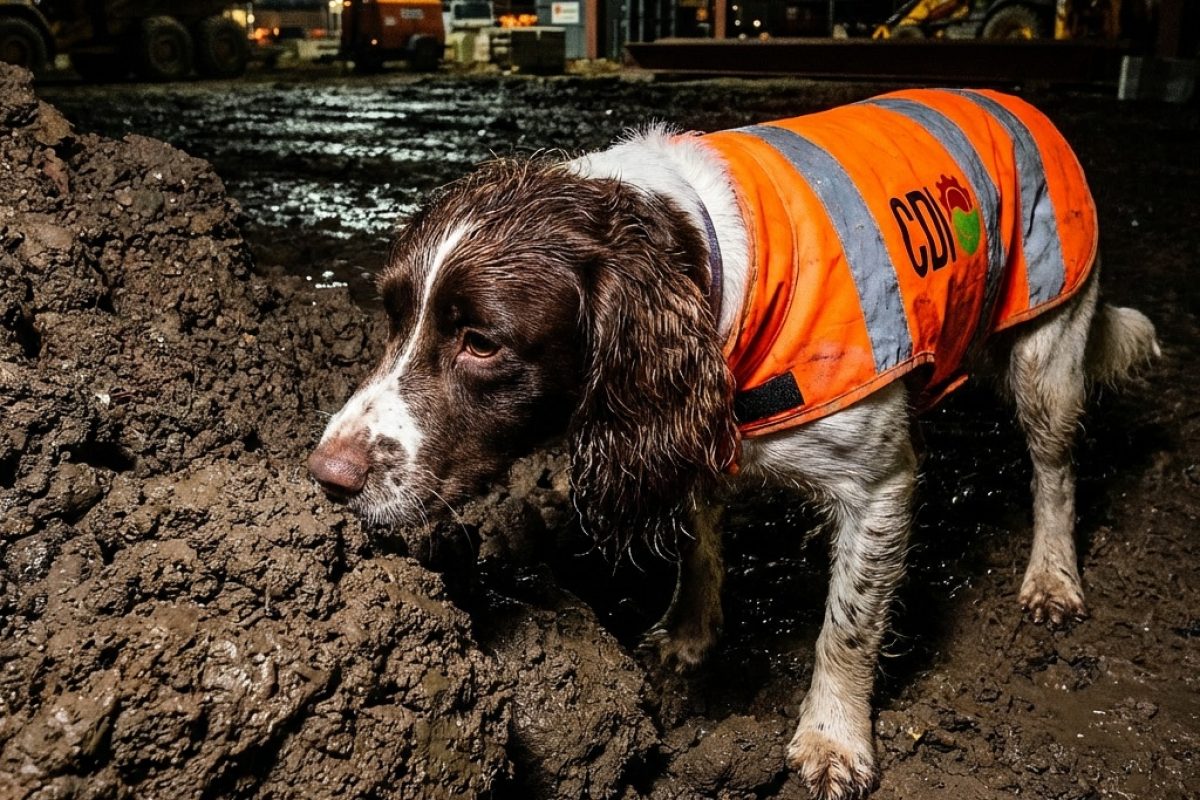
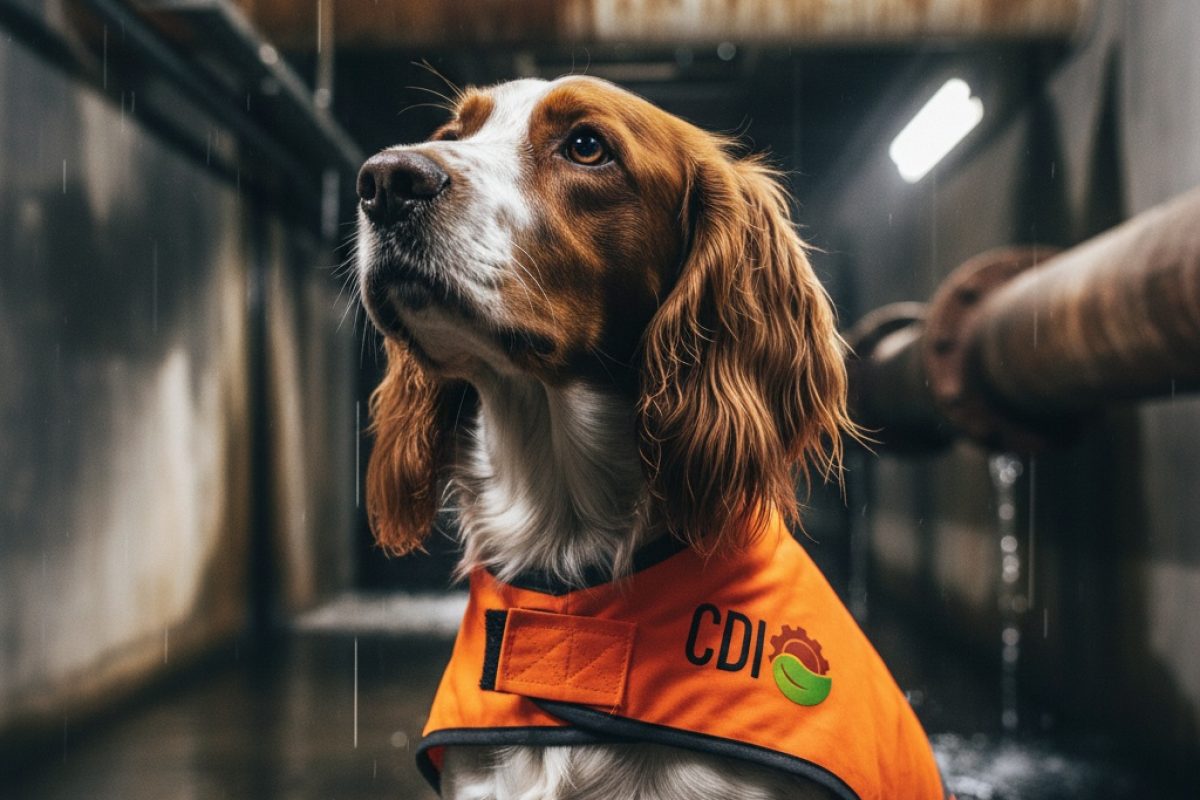
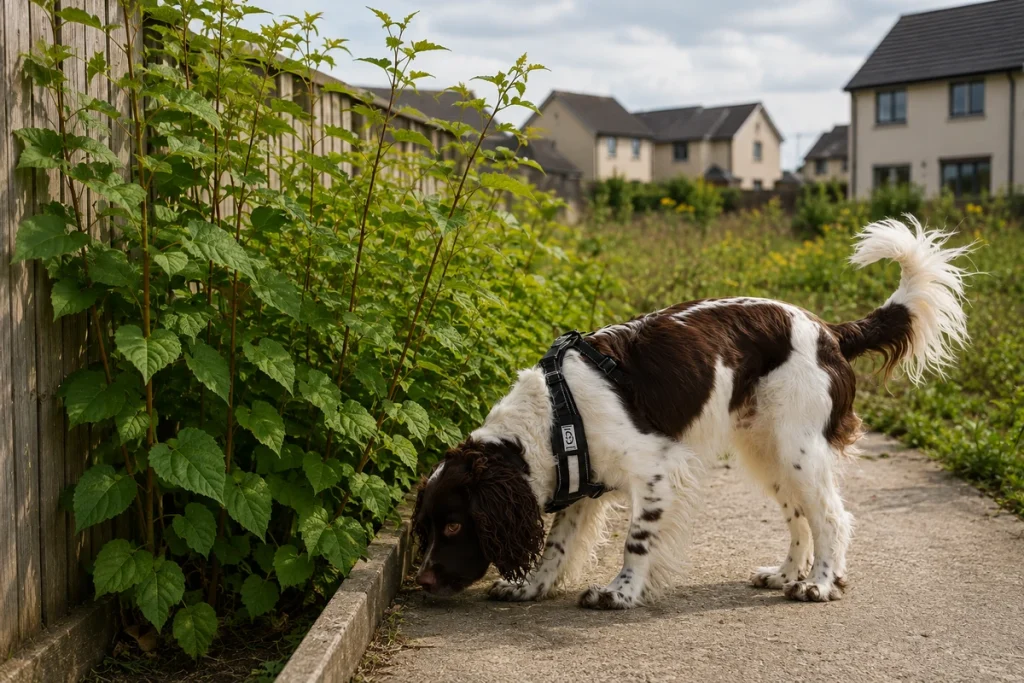
This is where a professional survey can be valuable. Rather than relying only on assumptions, a survey can help assess whether your side of the boundary may require further investigation. CDI’s Japanese knotweed detection dogs are trained to identify the scent of Japanese knotweed, including concealed or underground growth, which can support clearer decision-making where visual evidence is limited.
What should you do first?
If you think Japanese knotweed is growing on neighbouring land, the first step is to avoid disturbing the area. Do not dig near the suspected boundary. Do not cut, strim, mow or remove plant material. Do not move soil from the area. Do not assume that removing visible stems will solve the issue.
Disturbance can make the problem worse if viable plant material or rhizomes are moved. Even well-intentioned clearance can increase risk if it is done without understanding where the knotweed may be present.
The next step is to record what you have noticed. Take clear photographs from your side of the boundary where possible. Note the date, the location and any visible signs, such as old canes, fresh shoots, dense growth, cut stems or growth appearing near a fence line. If the concern has been raised during a property survey or by a contractor, keep that information as well.
After that, consider whether your own land needs to be checked. This is particularly important if you are planning to sell, buy, develop, excavate, landscape or clear the area. A professional Japanese knotweed survey can help establish whether the risk may affect your property or site, even if the main visible growth appears to be next door.
Should you speak to the neighbour?
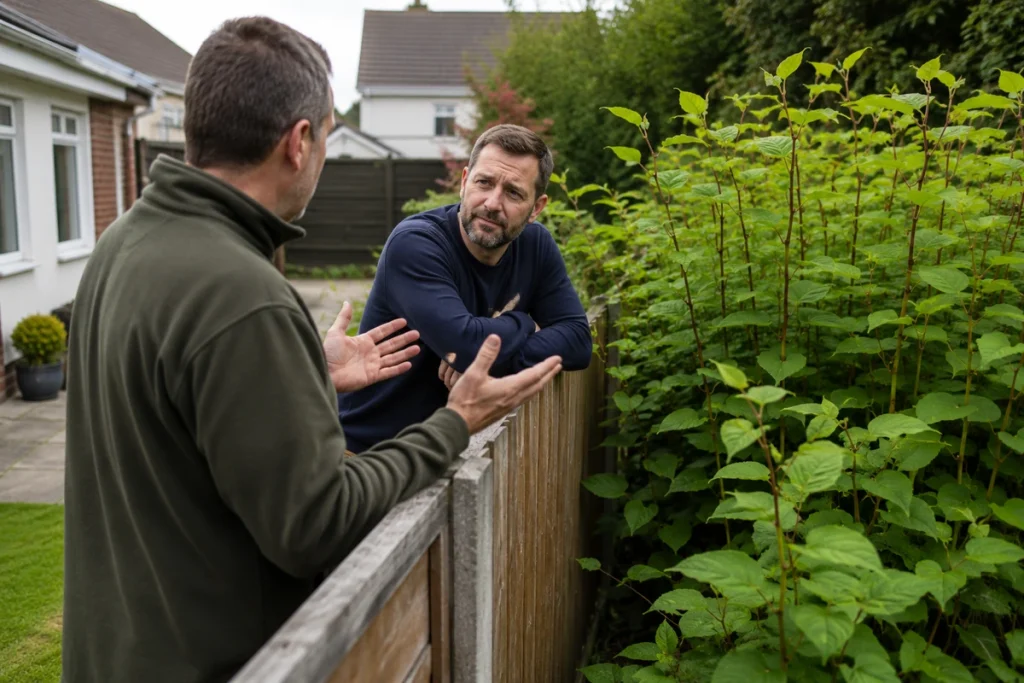
In many cases, it is sensible to speak to the neighbouring landowner in a calm and practical way. The goal should be to share the concern, not to create conflict. The neighbour may not know the plant is present, may not realise the risk, or may already be arranging advice.
A simple conversation can sometimes lead to a better outcome for both sides. If the plant is confirmed, both properties may benefit from coordinated professional advice. Japanese knotweed management is often more effective when the full area of risk is understood rather than treating one side of a boundary in isolation.
However, it is also important to protect your own position. If you are worried that the plant may have spread onto your land, or if a sale, purchase or building project is involved, you may not want to rely only on what the neighbour says. Their visual view of the issue may be limited, and they may not have checked the underground risk.
A detection survey on your own land can provide more useful information for your decisions. It can help you understand whether the suspected knotweed is only nearby or whether there may be a direct risk to your property, boundary or planned works.
Why detection matters before making accusations
Boundary knotweed issues can become emotional very quickly. A homeowner may feel angry that a neighbour has not dealt with the plant. A neighbour may feel blamed for something they did not know about. A buyer may become nervous and threaten to withdraw from a purchase. A contractor may refuse to continue until the issue is clarified.
This is why evidence matters.
Before making strong claims, it is better to confirm what is actually present and where the risk may be. Japanese knotweed can sometimes be confused with other plants, especially by people who are not familiar with its seasonal appearance. In winter, old canes and dead-looking growth can make identification even more uncertain.
A professional detection survey can help move the situation away from guesswork. It provides a clearer basis for deciding what should happen next, whether that involves further investigation, specialist treatment advice, communication with a neighbour or changes to planned works.
For property transactions, this clarity can be especially useful. If Japanese knotweed is suspected near a boundary, buyers and sellers often need practical information rather than assumptions. CDI’s article on property survey issues explains how knotweed concerns can affect the purchase process and why early clarification can help reduce uncertainty.
What if the neighbour has cut it back?
Cutting Japanese knotweed back does not necessarily remove the problem. It may make the area look tidier, but the underground rhizome system can remain in place. In some cases, cutting can make visual identification harder because the most obvious above-ground signs have been removed.
This can be frustrating if you are trying to understand whether the plant has spread toward your property. A boundary that looked heavily affected in summer may look clear later in the year after cutting, clearance or dieback. However, a clear-looking boundary is not the same as a confirmed knotweed-free boundary.
If the neighbour has cut back the plant, it may still be important to arrange a survey before any soil movement, landscaping, fencing or construction work on your side. The concern is not only what can be seen today. The concern is whether viable material remains below ground.
This is also why photographs and dates can be helpful. If you noticed visible knotweed earlier in the year, keep a record. Seasonal change or cutting can alter how the site looks, but earlier evidence may still help explain why further checks are needed.
What if you are buying a property next to knotweed?
If you are buying a property and Japanese knotweed is visible or suspected on neighbouring land, it is sensible to take the concern seriously before completing the purchase. Even if the plant is not clearly inside the property boundary, the proximity may still raise questions.
The key issue is whether the property you are buying may be affected now or could be affected in future. A standard viewing will not answer that question. A general property survey may flag a concern, but it may not fully assess underground spread or boundary risk.
Before making a final decision, you may need more specific information. A professional detection survey can help establish whether Japanese knotweed risk should be considered as part of your purchase decision. It can also help guide discussions with your solicitor, surveyor, lender or estate agent.
This does not mean every nearby knotweed concern should stop a purchase. It means the risk should be understood before decisions are made. Clarity is better than uncertainty, especially when future maintenance, resale value, insurance, lending confidence or garden works may be affected.
What if you are selling a property?
If you are selling a property and Japanese knotweed is present or suspected on neighbouring land, it is better to deal with the concern early rather than wait for a buyer’s survey to raise it.
A buyer may become nervous if they notice suspicious growth near a boundary and the seller has no information. Even where the knotweed is not confirmed on your land, uncertainty can slow the process and lead to additional enquiries.
A detection survey can help you understand your position before the property goes further into the sales process. If no evidence is found on your side, that information may help reassure buyers and advisers. If risk is detected, you can seek appropriate advice and avoid being surprised later.
Early action can also help you communicate more clearly. Instead of saying you are unsure, you can explain that the concern has been professionally checked and that the next steps are being handled responsibly.
This can make a difference when the goal is to keep a transaction moving.
What if work is planned near the boundary?
If you are planning work near a boundary where Japanese knotweed is known or suspected, arrange checks before the work begins. This includes fencing, drainage, landscaping, extensions, garden clearance, excavation, trenching, driveway work, demolition, redevelopment and utility works.
The risk is highest when soil is disturbed or moved. If rhizomes are present and the ground is excavated without controls, knotweed material can be spread across the site or into previously unaffected areas. That can make the problem more expensive and more disruptive than it needed to be.
This is particularly important for contractors and developers because a boundary issue can quickly become a project issue. If Japanese knotweed is discovered during works, there may be delays while the area is assessed and the correct management plan is arranged.
CDI’s guidance on contaminated soil movement explains why soil handling is such an important part of knotweed risk. Before work begins, detection can help identify whether the boundary area needs further attention.
Commercial and development sites with neighbouring knotweed
Neighbouring Japanese knotweed can be a serious due diligence issue for commercial and development sites. A site may appear suitable for purchase or redevelopment, but nearby knotweed can still affect risk planning.
This is especially relevant where the neighbouring land is unmanaged, vacant, industrial, public, infrastructural or difficult to access. Knotweed may be present along adjoining boundaries, access roads, embankments, watercourses or service corridors. Even if the visible plant is outside the site, the development team may still need to understand whether the project boundary is affected.
For developers, timing matters. If a boundary knotweed issue is discovered after acquisition, after planning assumptions or during site preparation, the impact can be wider than expected. It may affect groundworks, drainage, fencing, service installation, landscaping, soil disposal and contractor sequencing.
A professional survey before purchase or before mobilisation can reduce uncertainty. It helps developers, commercial buyers and site managers understand whether knotweed risk should be included in the project plan.
For broader site preparation, CDI’s article on construction site knotweed is also relevant.
Why a detection survey can help convert uncertainty into action
When Japanese knotweed is on neighbouring land, many people delay action because they are unsure what they are responsible for. They may hope the neighbour will deal with it. They may assume it has not crossed the boundary. They may wait until the next growing season to see what happens.
Waiting can sometimes make the issue more complicated.
A detection survey gives you a practical starting point. It helps answer the question that matters most to you: is my land at risk? Once that question is addressed, the next steps become easier to decide.
If no risk is detected on your side, you may have more confidence before selling, buying or starting work. If risk is detected, you can seek the right advice before disturbing soil or making costly decisions. Either way, you are making decisions based on information rather than assumption.
That is the main value of CDI’s work in neighbouring land situations. The service is not just about identifying a plant. It is about helping property owners, developers and land managers understand hidden risk before it becomes a bigger problem.
When to contact CDI
You should contact CDI if Japanese knotweed is visible or suspected near your boundary and you need to make a property, land or construction decision. This includes buying, selling, developing, clearing, excavating, landscaping or managing land next to a suspected infestation.
You should also arrange advice if a surveyor, neighbour, contractor or buyer has raised a concern. Even if the issue is not yet confirmed, early detection can help prevent unnecessary delays and reduce uncertainty.
CDI can carry out a professional detection survey to help identify whether Japanese knotweed may be present on your land, including hidden or concealed growth that may not be obvious through visual inspection alone.
If neighbouring Japanese knotweed is creating uncertainty, the best next step is to confirm the risk before taking action.
Final thoughts
Japanese knotweed on neighbouring land should not be ignored, but it should also not be handled through guesswork or panic. The plant may appear to sit on the other side of a boundary, but the underground risk may need to be checked before you make decisions about buying, selling, clearing or developing land.
The safest approach is to avoid disturbance, record what you have seen, communicate carefully where appropriate and arrange a professional detection survey if your land may be affected.
A boundary concern does not always mean your property has Japanese knotweed. However, it does mean you should get clarity before the issue affects a sale, purchase, project or groundworks plan.
If you are worried about Japanese knotweed on neighbouring land in Ireland, CDI can help assess the risk and support informed next steps.
FAQs
Is my neighbour responsible for Japanese knotweed spreading into my property?
In Ireland, landowners are expected to ensure they are not causing or allowing Japanese knotweed to spread. If you believe knotweed from neighbouring land may be affecting your property, it is sensible to seek professional advice and confirm the risk before taking further action.
Can Japanese knotweed spread under a fence?
Japanese knotweed can spread through underground rhizomes, so a fence does not necessarily stop the risk. Even if the visible plant is on the other side, the underground system may need to be checked.
Should I cut Japanese knotweed coming through from next door?
No, you should not cut, dig or disturb suspected Japanese knotweed without proper advice. Cutting visible growth does not remove the underground rhizomes and can make the issue harder to manage if plant material is spread.
Can I sell my house if Japanese knotweed is next door?
You may still be able to sell, but nearby Japanese knotweed can raise questions during the survey or legal process. A professional detection survey can help clarify whether your property may be affected.
What should I do if my neighbour ignores Japanese knotweed?
Start by keeping records and seeking professional advice about your own land. A detection survey can help establish whether there is risk on your side of the boundary before further steps are considered.
Does Japanese knotweed always spread to neighbouring property?
Not always. The risk depends on the location, the extent of the infestation, soil conditions, disturbance, boundaries and management history. However, because the plant can spread underground, suspected boundary growth should be checked carefully.
Can detection dogs check boundary areas?
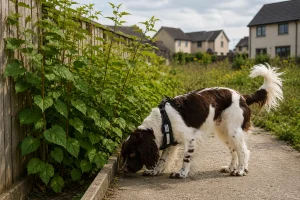
Yes, detection dogs can be useful where Japanese knotweed is suspected near a boundary, especially when visual signs are limited, concealed, cut back or difficult to access.
When should I arrange a survey?
You should arrange a survey before buying, selling, clearing, excavating, landscaping or developing land where Japanese knotweed is visible, suspected or known to be present nearby.