
Understanding where corrosion under insulation starts can make a CUI inspection programme significantly more effective. Corrosion under insulation does not develop with the same likelihood across every metre of insulated pipework or every section of a vessel. Certain areas are more vulnerable because they provide easier routes for moisture to enter the insulation system, allow water to remain trapped against the metal or experience operating conditions that repeatedly expose the surface to moisture. Recognising these patterns gives asset managers, inspection teams and reliability engineers a much stronger basis for deciding where detailed inspection should be concentrated.
This matters because inspecting insulated equipment presents a practical challenge. Removing insulation across large areas of a process plant can require considerable labour, access arrangements and reinstatement work, while choosing too few inspection locations can leave active corrosion undiscovered. Rather than treating every insulated surface as equally likely to suffer CUI, plant teams can begin by identifying credible high-risk areas and then prioritise inspection according to asset condition, operating history and the consequences of failure.
Moisture is central to the problem. Rainwater, condensation, process leaks, wash-down water and other sources can enter through damaged jacketing, poor seals, penetrations or interruptions in the insulation system. Once water reaches the underlying metal, the insulation can retain it and conceal deterioration from normal external inspection. For facilities managing large insulated networks, CDI’s early corrosion detection service can provide an additional non-intrusive screening layer when teams need to narrow down which locations deserve closer engineering investigation.
Where does corrosion under insulation usually start?
Corrosion under insulation commonly develops where moisture can reach the underlying metal and remain there long enough to create corrosive conditions. Importantly, the location where water enters the insulation and the location where corrosion eventually develops are not necessarily the same. Moisture can migrate through insulation, follow a pipe surface or move towards lower areas before becoming trapped. A weatherproofing defect several metres away may therefore provide the original entry route while deterioration develops around a support, fitting or low point where water accumulates.
This is why CUI inspection planning needs to consider moisture pathways rather than simply looking for external damage directly above a suspected problem. Teams should ask how water could enter the system, where it would be likely to travel and which parts of the asset are least likely to dry effectively. Geometry, service temperature, insulation condition, previous repairs and exposure to external water can all influence where CUI eventually becomes established.
The most useful inspection points are therefore often locations where several risk factors overlap. CDI’s broader early corrosion detection approach is based on the same principle of identifying early corrosion activity before visible deterioration or more significant damage develops.
Damaged jacketing and failed weather seals
Damaged insulation jacketing is one of the clearest reasons to consider an area higher risk. Open seams, dents, splits, loose sections, missing bands and poorly repaired cladding can compromise the weather barrier and provide a route for rainwater or process moisture to enter. What appears to be a relatively small external defect may gradually wet a considerably larger area of insulation underneath, particularly when the damaged section experiences repeated exposure.
Weather seals and caulking deserve similar attention. Sealants can crack, harden, separate or lose adhesion as they age, particularly where they are exposed to temperature changes, vibration or weather. Once a small gap develops, water can enter the insulation more easily than it can escape. Bulging or stained jacketing can also indicate that moisture has entered or that the insulation beneath the outer jacket has deteriorated.
For routine plant walkdowns, these defects should be recorded as more than cosmetic maintenance issues. Their importance increases when they occur on older equipment, safety-critical systems or assets with limited recent inspection history. The external defect does not prove that corrosion exists underneath, but it creates a logical reason to increase the inspection priority of the area.
Pipe supports, shoes and hangers
Pipe supports are important CUI inspection points because they interrupt what would otherwise be a relatively continuous insulation system. Shoes, clamps and hangers introduce additional joints, edges and interfaces that can be more difficult to seal effectively. Mechanical movement or vibration can also damage the surrounding jacketing over time, while restricted access can make maintenance around these areas more difficult.
Moisture behaviour adds to the concern. Water entering somewhere else along an insulated line may travel beneath the insulation and collect around lower surfaces or complicated support details. Insulation packed closely around a shoe or clamp may also remain damp longer than an exposed straight section, creating conditions in which the underlying metal receives prolonged moisture exposure.
For long runs of insulated pipework, supports should therefore not be considered equivalent to uninterrupted straight sections. A support with ageing insulation, visible seal deterioration, historical repairs or regular water exposure represents a much stronger candidate for investigation than a dry, recently installed section with intact weatherproofing.
Insulation terminations around valves, flanges and fittings
Valves, flanges and fittings create another important group of CUI high-risk areas because the insulation system must stop, change shape or accommodate components that require maintenance access. Maintaining effective weatherproofing around these transitions can be more difficult than maintaining it along a continuous pipe run, and small openings can develop around insulation edges as materials age or move.
Maintenance history is especially relevant around these components. Insulation may have been removed to access a flange or valve and then reinstated once work was completed. Even when the reinstated insulation looks satisfactory externally, repeated removal and replacement can introduce weaknesses in surrounding seals or jacket interfaces. A fitting that has been accessed multiple times may therefore justify closer attention even if no dramatic external damage is currently visible.
Inspection teams should also look beyond the exposed fitting. If moisture enters where insulation terminates beside a flange, the resulting CUI may develop beneath the adjoining insulated pipe rather than directly on the visible component. The entire transition area should therefore be considered when defining inspection points.
Nozzles, manways and other insulation penetrations
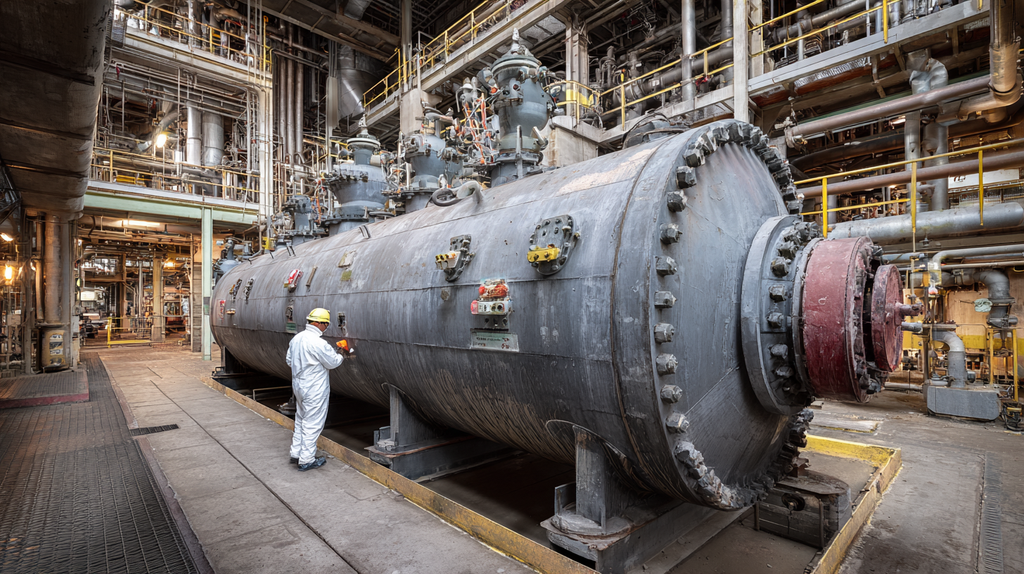
Any feature that penetrates an insulation system creates another potential weakness in the weather barrier. Vessel nozzles, manways, instrument connections, brackets and structural attachments all require careful sealing where they pass through the insulation jacket. Ageing sealants, movement and routine maintenance can gradually make these interfaces more vulnerable to moisture ingress.
The problem can be particularly relevant on larger vessels where a single asset contains numerous penetrations at different elevations. A relatively small defect around one penetration may allow water to enter the insulation and migrate beyond the immediate opening, meaning the visible condition of the seal does not necessarily show the full area that could have been exposed.
Maintenance records can help identify which penetrations deserve additional attention. Areas that have been opened repeatedly for instrument work, inspection or maintenance may carry greater uncertainty than undisturbed sections. Plant teams should therefore consider how the insulation has been treated over its entire service life, rather than relying only on how the installation looks today.
Branch connections and changes in geometry
Branch connections, elbows, reducers and other changes in geometry make insulation installation more complex. A smaller pipe joining a larger line creates additional seams and transitions, while bends and changes in direction can make it more difficult to maintain consistent weatherproofing as the insulation system ages.
Geometry can also influence where moisture travels after entering the system. Water can migrate around a bend or towards the lower side of a fitting before remaining trapped. The external defect that allowed moisture into the insulation may therefore be some distance from the point where the most significant corrosion develops.
This makes geometry-based inspection planning more useful than simply selecting locations at fixed distances along the pipe. Removing insulation every predetermined number of metres may expose sound surfaces while missing the physical features that are genuinely more susceptible to moisture ingress or retention. Prioritising changes in geometry gives the inspection programme a stronger technical basis.
Low points and the bottom of vertical pipe runs
Gravity becomes important once water has entered an insulation system. Moisture can move through insulation or along the metal surface and collect lower than the original entry point. As a result, the lower section of a vertical pipe run may experience prolonged moisture exposure even when the jacket at that exact location remains visually intact.
Low points in horizontal or inclined pipework can present a similar concern. If water enters through a damaged seam, penetration or fitting further along the line, it may migrate towards these areas and remain there longer than on neighbouring surfaces. Poor drainage and dense insulation can increase the length of time required for the affected area to dry.
Inspection teams should therefore assess low points in relation to the wider system. A low section beneath a known weatherproofing defect may carry increased CUI risk even when no local jacket damage is visible. Looking at potential water movement rather than only local defects can reveal inspection priorities that would otherwise be missed.
Dead legs, vents and drains
Dead legs, vents and drains can experience very different operating conditions from the main process line. Some remain close to ambient temperature for long periods, while others operate only intermittently or repeatedly heat and cool. These differences can influence condensation, evaporation and the amount of time moisture remains underneath the insulation.
Such components may also receive less attention during normal operations because they are not part of the continuously flowing section of the system. Inspection intervals may be longer and the condition of insulation on smaller connections can receive less scrutiny than the main pipework. That does not make them lower risk by default.
A dead leg can have the same construction material and insulation system as the adjoining main line while experiencing a completely different thermal history. Asset teams should therefore consider the actual service conditions of the individual component rather than assuming that all connected sections share the same CUI risk profile.
Cold service and areas prone to condensation
Cold-service pipework presents another important CUI scenario because moisture does not necessarily need to arrive through rainfall or an external leak. When the vapour barrier is damaged, humid air can reach a sufficiently cold surface and condensation can form within the insulation system.
Joints, insulation terminations, penetrations and previously repaired areas become particularly important because these are common locations where the vapour barrier can lose continuity. The outer jacketing may continue to appear relatively sound even while moisture repeatedly forms underneath it.
CUI inspection planning on cold systems should therefore consider actual operating temperature alongside the physical condition of the insulation. Looking only for rainwater ingress can underestimate risk where condensation is the dominant moisture source. Locations that operate below the surrounding dew point and have a history of insulation disturbance deserve appropriate attention within the inspection programme.
Intermittent service and thermal cycling
Equipment that repeatedly heats up and cools down can create additional challenges for insulation systems. Thermal expansion and contraction place stress on seals, joints and cladding, gradually creating small gaps or weaknesses that may not have existed when the system was initially installed.
Temperature changes can also influence how existing moisture behaves beneath the insulation. Heating may cause water to move through the insulation system, while cooling can create conditions that support additional condensation. Repeated cycling can therefore produce complex wetting and drying patterns that are not obvious from the operating temperature observed during one site visit.
Service history should form part of CUI inspection planning for this reason. Equipment that runs intermittently, experiences regular shutdowns or repeatedly crosses different operating temperatures should not automatically receive the same inspection priority as continuously operating equipment under otherwise similar conditions.
Areas exposed to wash-down, leaks and external water
Rain is only one source of moisture capable of contributing to CUI. Industrial equipment may also be exposed to wash-down operations, process leaks, steam, spray, cooling water, drainage problems or water from equipment located above. An insulated line situated indoors can therefore experience substantial moisture exposure even though it never receives direct rainfall.
Understanding the surrounding operating environment is essential. A relatively ordinary section of pipework located beneath equipment that is regularly washed may have greater CUI potential than a similar asset positioned in a dry outdoor location with effective weatherproofing. Repeated wetting can also deteriorate the outer jacket and sealants over time, making subsequent water ingress increasingly likely.
Plant teams should therefore evaluate the environment around the asset rather than considering the insulation system in isolation. Routine operations, cleaning practices and known leaks can reveal high-risk inspection locations that are not obvious from engineering drawings or asset specifications.
Previously repaired insulation and older installations
Repair history is another useful indicator when defining CUI inspection points. Insulation that has been opened for previous maintenance, inspection or repair may have been removed and reinstated several times over the life of the asset. Each intervention provides another opportunity for the original weather or vapour barrier to change.
Even a well-completed repair can age differently from the surrounding original installation. Replacement cladding, patch materials and sealants may have been installed at different times and can respond differently to vibration, temperature and environmental exposure. Temporary repairs may also remain in service far longer than initially intended.
Older installations deserve additional consideration because they have experienced longer periods of weather exposure, maintenance activity and potential historical water ingress. Age alone does not demonstrate that CUI is present, but age combined with repeated repairs, deteriorated jacketing, moisture exposure and limited inspection data creates a stronger reason to investigate.
What external signs should plant teams look for?
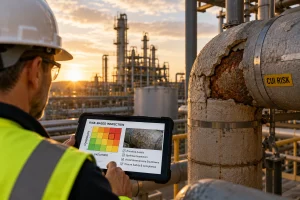
External inspection remains valuable because several visible conditions can indicate increased CUI risk. Staining, bulging cladding, loose jackets, cracked sealants, missing bands, impact damage, open seams and visible wet insulation should all be documented during plant walkdowns. Repeated repairs around the same location can also suggest that a persistent problem has not been fully resolved.
The key limitation is that these signs indicate risk rather than proving the condition of the underlying metal. A damaged jacket may be identified before corrosion develops, while active CUI may be hidden beneath an area that appears relatively normal externally. The absence of visible damage should therefore not be treated as confirmation that the underlying surface is corrosion-free.
Plant teams wanting more background on how hidden corrosion can be approached can also review CDI’s corrosion inspection resources, which cover early detection and the relationship between non-intrusive screening and traditional inspection methods.
How should CUI inspection points be prioritised?
A strong CUI inspection strategy considers combinations of risk rather than relying on one characteristic in isolation. An ageing pipe support with deteriorated seals, regular wash-down exposure and limited recent inspection history presents a stronger reason for investigation than a recently installed straight section of pipe in a dry and protected environment.
Asset consequence also needs to be considered. A component may have only moderate evidence of increased CUI likelihood but still justify early inspection if a failure could create significant safety, environmental or production consequences. Inspection planning therefore needs to balance probability with the potential impact of loss of containment.
The objective is not to create the largest possible list of suspect areas. It is to identify which inspection points will provide the greatest integrity value. Where hundreds or thousands of possible risk locations exist, a prioritised strategy can help the asset team use intrusive inspection, scaffolding and NDT resources more effectively.
Why random inspection points can miss important CUI risk
Random or fixed-distance inspection programmes are relatively easy to administer, but they do not necessarily correspond with the areas where CUI is most likely to occur. Two sections of the same pipe may have very different risk profiles because one contains a support, insulation termination or repeated repair while the other is an intact straight section.
A random approach can therefore result in insulation being removed from sound areas while a more vulnerable interface remains untouched. Across extensive industrial pipework, repeated inspection of low-value locations can generate significant cost without producing the same level of confidence as a well-prioritised programme.
Risk-based selection provides a more defensible starting point. Inspection findings can then be fed back into future planning, allowing the facility to understand which asset features and service conditions are actually associated with corrosion on its own site rather than relying solely on general industry assumptions.
Why visual inspection alone can leave uncertainty
A visual walkdown can identify damaged cladding, poor seals and obvious moisture-entry points, but it cannot show the condition of the metal beneath every apparently intact section of insulation. This is one of the fundamental difficulties associated with CUI: the insulation conceals both the metal surface and the environment immediately surrounding it.
Removing insulation from every potentially vulnerable location is rarely practical. It may require scaffolding, labour, insulation reinstatement and interruption to normal plant activities. At the same time, relying entirely on external appearance can leave hidden activity unresolved. Additional non-intrusive screening can therefore be useful when the objective is to reduce the inspection footprint before more detailed verification begins.
CDI’s non-intrusive corrosion detection methodology is designed to support this type of risk-based planning by providing another source of information before widespread strip-and-look inspection. It does not remove the need for engineering verification where metal condition needs to be quantified, but it can help teams determine where that verification may provide the most value.
How early detection can support CUI inspection planning
Knowing the typical CUI high-risk areas is only the first stage. A large facility may contain hundreds of pipe supports, penetrations, flanges, valves, dead legs and ageing insulation sections, all of which appear to satisfy at least one general risk criterion. Investigating every location intrusively can quickly become unrealistic.
Early screening can add another layer of evidence to the prioritisation process. When screening results are considered alongside asset criticality, service history, visual condition and previous inspections, integrity teams can make more informed decisions about which locations should progress to targeted NDT or direct examination.
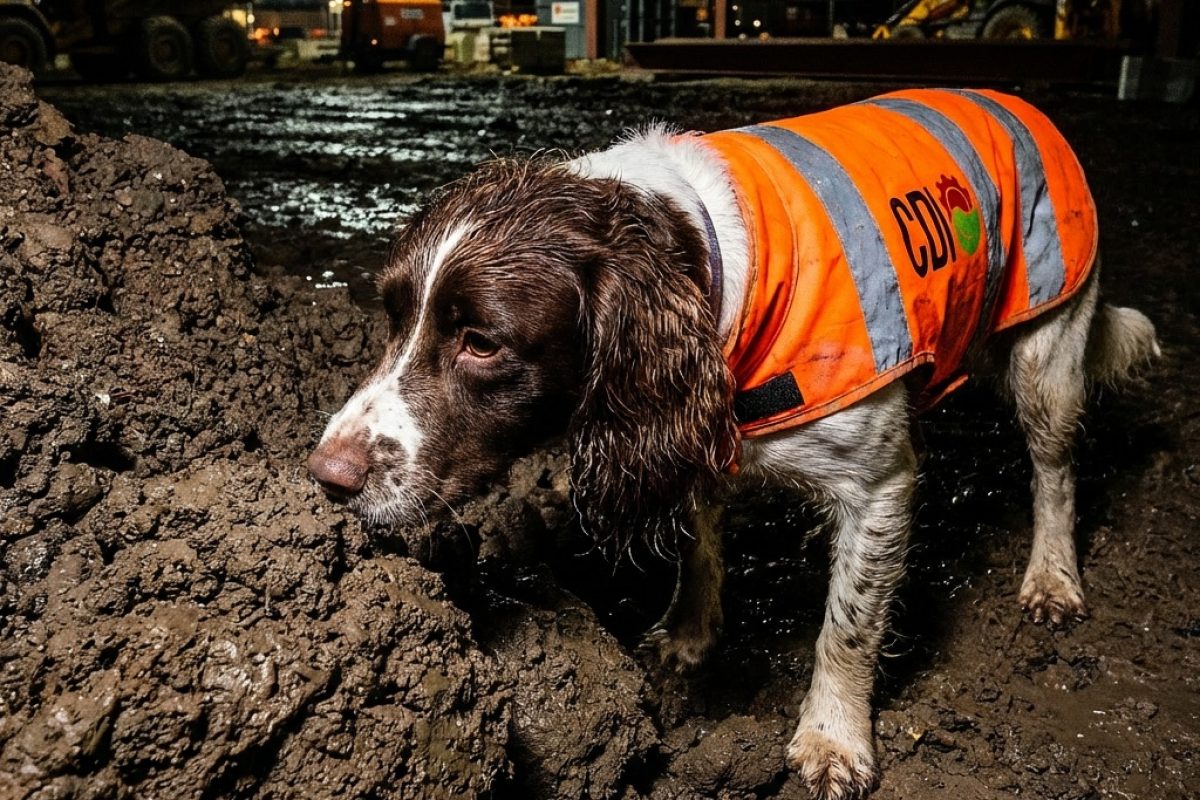
This approach is particularly useful where access is expensive or turnaround time is limited. CDI’s wider industrial detection capability includes on-site VOC detection and methods intended for complex or difficult-to-access environments, allowing screening to form part of a broader integrity-management strategy rather than operating as a standalone inspection exercise.
How CDI has applied targeted CUI screening
A useful example can be seen in CDI’s CUI detection case study. The project involved ageing insulated pipework at an operational facility where the operator needed a more targeted way of assessing corrosion risk rather than immediately committing to widespread insulation removal. The survey process used asset information and known risk factors to focus screening before follow-up inspection was considered.
The important lesson for asset managers is not simply that corrosion was identified. The value lies in narrowing uncertainty across a wider network so that detailed inspection can be directed towards the areas where evidence provides a stronger reason for concern. This distinction is especially important when hundreds of metres of insulated pipework may otherwise be treated as equally suspect.
CDI has also documented the application of early-stage VOC corrosion detection within a pharmaceutical facility CUI project, illustrating how non-intrusive screening can support engineering teams where broad insulation removal would create unnecessary disruption to an operational site.
How screening fits within an existing integrity programme
Early detection should not be treated as a replacement for established engineering inspection. Where remaining wall thickness, metal loss, damage mechanisms or fitness for service need to be determined, appropriate NDT and engineering assessment remain essential. Screening serves a different purpose: helping teams decide where those more detailed inspection methods should be concentrated.
This distinction becomes particularly valuable for plants with large quantities of ageing insulated equipment. Screening can help reduce uncertainty across a wider asset population, while intrusive methods can then be reserved for specific areas that warrant quantification or engineering confirmation.
Teams evaluating how this approach has been used across different project types can review CDI’s industrial case studies. The examples demonstrate the broader principle of using early information to narrow risk and support more targeted follow-up decisions rather than applying invasive investigation indiscriminately across an entire site.
How CDI can support CUI inspection planning
CDI provides early corrosion screening for insulated pipework, industrial equipment and other infrastructure where hidden corrosion can be difficult to assess without intrusive work. A survey can be structured around the facility’s existing risk assessment, operating conditions, maintenance history and access restrictions rather than treating every asset as having the same likelihood of CUI.
Higher-priority sections can be screened first, indications can be documented and the integrity team can then determine where conventional follow-up inspection is required. This allows the screening process to complement the site’s existing inspection programme rather than creating a separate decision-making system.
For facilities with extensive insulated networks, this approach can be particularly useful when the main challenge is not understanding what CUI is, but deciding where limited inspection resources should be applied first. The strongest outcome is a clearer and more defensible inspection priority rather than simply generating additional inspection activity.
Final thoughts
If you are trying to understand where corrosion under insulation starts, begin with locations where moisture is most likely to enter or remain trapped. Damaged jacketing, deteriorated seals, supports, insulation terminations, penetrations, low points, dead legs and areas exposed to condensation or repeated external water all deserve particular attention. Their importance increases further when they occur on ageing assets, previously repaired insulation or systems with demanding thermal and operating histories.
A strong CUI inspection programme should therefore do more than remove insulation at arbitrary intervals or react only when external deterioration becomes obvious. It should build a risk picture, identify credible high-priority locations and then apply appropriate screening and engineering verification methods to resolve uncertainty.
Where a facility contains large areas of insulated pipework and needs to narrow down where intrusive inspection should be focused, CDI’s early corrosion detection service can support risk-based inspection planning while reducing unnecessary disturbance across lower-priority assets.
Frequently asked questions
Where does corrosion under insulation usually start?
Corrosion under insulation commonly develops where water or condensation reaches the underlying metal and remains trapped beneath the insulation. Damaged jacketing, deteriorated weather seals, pipe supports, terminations, penetrations and low points are common areas of concern because they either provide routes for moisture entry or increase the likelihood that water will remain in contact with the surface.
The corrosion location may not be exactly where the moisture originally entered. Water can migrate through insulation or move along the metal before collecting elsewhere, which is why inspection teams need to consider the wider moisture pathway rather than only visible local defects.
What are the main CUI high-risk areas?
Typical CUI high-risk areas include pipe supports and shoes, valves and fittings, insulation terminations, nozzles, branch connections, low points, dead legs, vents and drains. Areas with damaged jacketing, repeated insulation repairs, regular wash-down exposure, condensation or substantial thermal cycling can also deserve greater inspection priority.
The significance of each location should be assessed alongside operating history, asset age, previous inspection results and consequence of failure. A physical risk feature becomes much more important when several additional risk factors occur at the same location.
Why are pipe supports high-risk CUI inspection points?
Pipe supports interrupt the continuity of the insulation and create additional seams, interfaces and complicated areas that can be difficult to weatherproof effectively. Water may enter around shoes, clamps and hangers, while moisture entering elsewhere can also migrate towards the lower support area.
Restricted access, vibration and mechanical movement can make these locations more difficult to maintain as well. For these reasons, supports often make more logical inspection points than randomly selected straight sections of insulated pipe.
Can CUI occur when the insulation looks undamaged?
Yes. An intact-looking outer jacket does not confirm that the insulation underneath is dry or that the metal surface is free from corrosion. Moisture may have entered through another location, through a previous defect that has since been repaired or through an inadequately sealed penetration.
External condition remains valuable for assessing risk, but it should be considered together with service history, insulation age, moisture exposure and previous inspection information rather than being used as the only indicator.
Does CUI only affect hot pipework?
No. CUI can affect insulated equipment operating under different temperature conditions. Cold systems can be vulnerable where damaged vapour barriers allow condensation to form, while equipment subject to repeated thermal cycling may experience movement of moisture and progressive deterioration of seals and jackets.
Inspection priority should therefore be based on actual operating conditions and service history rather than assuming that CUI is limited to one type of temperature regime.
What visible signs can indicate increased CUI risk?
Staining, bulging jacketing, damaged cladding, cracked sealant, missing bands, wet insulation and repeated patch repairs can all indicate that an area deserves closer investigation. These conditions do not necessarily prove that corrosion is present, but they provide useful evidence that the insulation system may no longer be effectively controlling moisture.
Plant teams should also remember that significant CUI can exist without strong external warning signs. A good inspection programme therefore combines visible condition with wider asset and operating information.
Should insulation be removed at every suspected CUI location?
Not necessarily. The decision should take into account the likelihood of CUI, consequence of failure, asset criticality and the evidence already available. Removing insulation from every location that meets a broad generic risk criterion can create considerable cost without necessarily producing the most useful inspection coverage.
Risk-based prioritisation and suitable non-intrusive screening can help narrow the inspection area. Intrusive examination and NDT can then be directed towards locations where engineering confirmation is actually required.
How can early corrosion detection help with CUI inspection planning?
Early corrosion screening can help identify locations that warrant closer engineering investigation before widespread insulation removal begins. This is particularly valuable on large facilities where hundreds or thousands of potential CUI inspection points may exist but only a smaller proportion can realistically undergo intrusive inspection during a maintenance period.
The screening information should be used alongside asset criticality, maintenance history, visual condition and conventional inspection results. The purpose is not to replace engineering verification, but to help the integrity team decide where that detailed verification should be concentrated.