Japanese knotweed is one of the most frequently misidentified invasive plants in Ireland because several common garden plants, climbing vines and wild species share some of its distinctive characteristics. Homeowners often become concerned when they notice bamboo-like stems, reddish spring shoots, heart-shaped leaves or rapidly spreading vegetation along a garden boundary. However, not every fast-growing plant is Japanese knotweed, and incorrectly identifying ordinary vegetation as an invasive infestation can lead to unnecessary worry, unsuitable treatment and avoidable expenses. The opposite problem can be equally serious. When Japanese knotweed is mistaken for a harmless plant, it may continue growing unnoticed, allowing its underground rhizome system to establish beyond the visible area. This becomes especially important when purchasing property, preparing land for development, planning landscaping or investigating suspicious growth near neighbouring land. Understanding the differences between Japanese knotweed and similar-looking plants can help property owners recognise warning signs, avoid unnecessary disturbance and determine when professional detection is appropriate.
Why is Japanese knotweed commonly mistaken for other plants in Ireland?
Japanese knotweed can be difficult to identify because its appearance changes considerably throughout the year. During early spring, the plant produces reddish or purple shoots that can resemble young bamboo, asparagus or other emerging perennial vegetation. As the growing season progresses, the shoots develop into tall stems carrying broad green leaves, creating dense stands that may be confused with ornamental shrubs or other rapidly growing plants. By late summer, clusters of small creamy-white flowers provide another identifying feature, while autumn and winter bring changes that make identification more challenging.
Many plants found in Irish gardens and unmanaged areas share one or more of these characteristics. Bamboo has segmented stems, Russian vine produces large quantities of growth and pale flowers, and certain dogwood varieties develop brightly coloured shoots. Broad-leaved dock can resemble young knotweed because of its prominent foliage, while Himalayan balsam often grows in similar environments and can form dense colonies along riverbanks and damp ground.
The difficulty is that recognising one familiar feature does not necessarily confirm the identity of the entire plant. A hollow stem, for example, is not unique to Japanese knotweed, and several unrelated plants produce reddish growth during spring. Accurate identification requires examining a combination of features, including stem structure, leaf arrangement, growth habit, flowering characteristics and seasonal development.
There is also a distinction between identifying a visible plant and determining whether underground Japanese knotweed material remains present. A garden may contain no obvious knotweed during winter, yet viable rhizomes can remain beneath the surface. Similarly, a property where previous growth has been removed may appear clear even though the history of the infestation remains relevant.
For these reasons, identification should be based on several reliable characteristics rather than one photograph or a single feature. Where uncertainty could affect a property transaction, excavation or future land use, a professional Japanese knotweed detection survey can help investigate potential concealed growth and identify areas requiring further assessment.
What does Japanese knotweed actually look like?
Japanese knotweed, scientifically known as Reynoutria japonica, is a vigorous perennial plant that develops from an extensive underground rhizome system. Its above-ground growth changes throughout the year, making it important to understand how several characteristics work together rather than relying on one identifying feature.
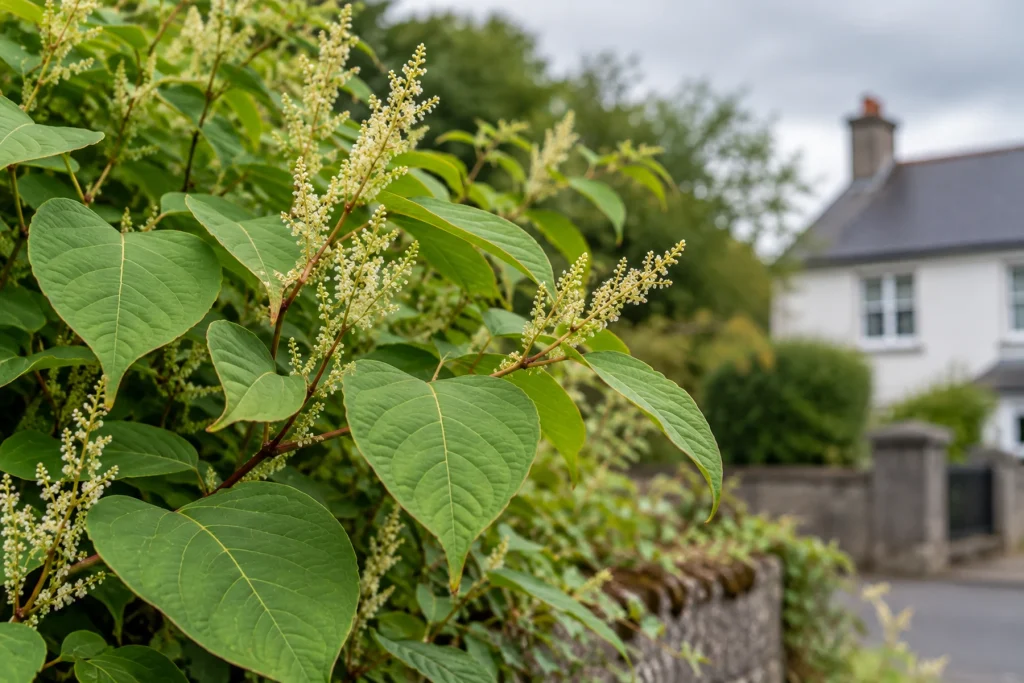
During spring, Japanese knotweed commonly produces reddish-purple shoots that emerge from the soil with a pointed appearance. These shoots can grow rapidly as temperatures increase, developing into upright stems with distinct nodes. Mature stems are generally hollow between the nodes and often display green colouring with reddish or purple markings.
The leaves are typically broad, with a pointed tip and a comparatively flat or straight base. They grow alternately along the stem, creating a distinctive zig-zag arrangement rather than appearing in directly opposite pairs. This arrangement is particularly useful when comparing Japanese knotweed with certain shrubs and ornamental plants.
During late summer and early autumn, Japanese knotweed produces clusters of small creamy-white flowers. These flowers can help distinguish the plant from species that produce brightly coloured blooms or larger individual flowers.
As winter approaches, the leaves disappear and the above-ground stems die back. Dry brown canes may remain standing, although cutting, clearance or weather conditions can remove much of this visible evidence. The underground rhizomes, however, can remain alive and produce new growth when conditions improve.
These characteristics are discussed in greater detail in CDI’s guide to identifying Japanese knotweed in Ireland. When comparing it with other plants, the most useful approach is to examine how the overall structure, leaf arrangement and seasonal behaviour differ from those of the suspected lookalike.
Japanese knotweed vs bamboo: How can you tell the difference?
Bamboo is one of the plants most commonly confused with Japanese knotweed because both can develop tall, segmented stems with a cane-like appearance. At first glance, a dense stand of knotweed may resemble an ornamental bamboo planting, particularly when viewed from a distance or during winter when the leaves are absent.
However, the two plants have several important differences. Most bamboo species develop woody or firm canes with long, narrow leaves. Japanese knotweed produces broader leaves that are typically shield-shaped or heart-shaped, with a pointed tip and a relatively straight base. Its stems are hollow and segmented but remain herbaceous rather than developing the same woody characteristics as mature bamboo.
Their leaf arrangements also differ. Japanese knotweed leaves occur alternately along the stems, often producing a noticeable zig-zag growth pattern. Bamboo leaves typically appear on branching structures associated with the nodes and are considerably narrower in shape.
Seasonal behaviour provides another clue. Japanese knotweed normally dies back above ground during winter, leaving dry brown canes. Many ornamental bamboo species retain substantial green foliage throughout the year, although this varies between species and environmental conditions.
Both plants can spread through underground structures, so observing spreading growth alone is not enough to distinguish them. Some running bamboo species can spread aggressively through rhizomes, creating their own garden-management problems. However, bamboo and Japanese knotweed are different plants, and their identification, management and legal considerations should not be treated as interchangeable.
Where a property owner is uncertain whether a dense cane-like plant is bamboo or Japanese knotweed, examining mature leaves, stem structure and seasonal growth can provide useful clues. If the plant is growing near an area scheduled for excavation or the identification remains unclear, professional assessment may be appropriate before disturbing the ground.
Japanese knotweed vs Russian vine: Why are they confused?
Russian vine, sometimes called mile-a-minute vine, is another fast-growing plant that can be mistaken for Japanese knotweed. The confusion is understandable because both belong to related groups within the knotweed family and can produce abundant vegetation and clusters of pale flowers.
The main difference is their growth habit. Japanese knotweed generally develops strong, upright stems that form dense stands, while Russian vine grows as a climbing or scrambling plant. It commonly spreads across fences, walls, trees and other supporting structures, using its flexible stems to cover large areas.
Russian vine may also produce clusters of small white or pinkish flowers that resemble Japanese knotweed flowers when viewed from a distance. However, the overall arrangement of the vegetation is different. A Russian vine infestation often appears as a climbing mass spread over existing plants or structures, whereas Japanese knotweed usually establishes upright canes emerging from the ground.
Leaves can provide additional identification clues, although they should be examined alongside the growth pattern. Russian vine leaves may vary in shape and generally occur along slender climbing stems rather than the sturdy, segmented canes characteristic of Japanese knotweed.
Because Russian vine grows so quickly, property owners may assume it presents the same risks as Japanese knotweed. Rapid growth alone, however, is not sufficient evidence of Japanese knotweed. Different plants require different identification and management approaches.
If the vegetation is climbing over a fence or spreading through nearby shrubs, Russian vine may be a possibility. If the plant forms upright cane-like stems with broad leaves arranged in a zig-zag pattern, Japanese knotweed becomes a more relevant concern.
Japanese knotweed vs bindweed: What are the differences?
Bindweed is a common garden weed in Ireland that can spread extensively through established borders, hedges and unmanaged vegetation. Its ability to cover nearby plants and reappear after removal sometimes leads homeowners to confuse it with Japanese knotweed.
The most obvious distinction is the way the plant grows. Bindweed typically produces thin, flexible stems that climb or twine around supporting vegetation. Japanese knotweed usually grows as an upright plant with comparatively thick, hollow, segmented stems that can support substantial above-ground growth.
Leaf shape also differs. Bindweed commonly produces arrow-shaped or heart-shaped leaves, depending on the species, but these leaves are generally smaller and attached to slender climbing stems. Japanese knotweed has broader leaves with a more distinctive flattened base and an alternating arrangement along the canes.
The flowers provide another useful distinction. Bindweed produces relatively large trumpet-shaped flowers, often white or pinkish. Japanese knotweed flowers are much smaller and occur in clusters, generally appearing toward the later part of the growing season.
A garden containing bindweed may still require ongoing weed management, but its presence should not automatically be treated as evidence of Japanese knotweed. Equally, homeowners should not dismiss suspicious upright knotweed stems simply because bindweed is also present nearby.
Where several plants are growing together, identification may become more complicated. Climbing bindweed can cover other vegetation, making it difficult to see the stems and leaves beneath. A careful examination of the overall growth pattern, without unnecessary digging or disturbance, can help identify which plants are actually present.
Japanese knotweed vs Himalayan balsam: How do they differ?
Himalayan balsam is another invasive plant found in Ireland, particularly in damp areas, riverbanks and disturbed ground. It can form tall, dense stands and compete with surrounding vegetation, which sometimes leads people to confuse it with Japanese knotweed.
One of the clearest differences is the appearance of the flowers. Himalayan balsam produces distinctive pink, purple or occasionally pale flowers with an unusual helmet-like shape. Japanese knotweed produces much smaller creamy-white flowers arranged in branching clusters.
The leaves are also different. Himalayan balsam typically develops elongated, lance-shaped leaves with toothed edges. These may occur opposite one another or in whorled arrangements. Japanese knotweed generally has broader, shield-shaped leaves with a pointed tip and a comparatively flat base, arranged alternately along the stem.
Himalayan balsam stems are usually smooth, fleshy and relatively fragile. Japanese knotweed produces more substantial cane-like stems with distinct nodes and reddish or purple markings. The two plants also reproduce differently. Himalayan balsam is an annual that primarily spreads through seeds, while Japanese knotweed persists through its extensive perennial rhizome system. This distinction is important because it affects how infestations are assessed and managed.
Although Himalayan balsam is not Japanese knotweed, it should not automatically be regarded as harmless. It is an invasive species in its own right and can affect native habitats, particularly along waterways. Where the plant’s identity is uncertain, examining flower shape, leaf arrangement and stem structure is more reliable than relying on its height or the fact that it grows in a dense colony.
Japanese knotweed vs broad-leaved dock: Why do the leaves look similar?
Broad-leaved dock is widespread in Irish gardens, grassland and disturbed ground. Young dock leaves can sometimes be confused with Japanese knotweed because both plants produce relatively large green leaves and may appear in similar locations. However, their overall growth habits are quite different. Broad-leaved dock generally forms a basal rosette, with leaves developing close to the ground before taller flowering stems emerge. Japanese knotweed produces upright, segmented stems carrying leaves at intervals along the plant.
Dock leaves are typically elongated or oval, often with noticeably wavy margins. Japanese knotweed leaves have a more distinctive shield-shaped outline, pointed tip and relatively straight base. When dock flowers and develops seeds, its appearance becomes increasingly different from Japanese knotweed. Dock produces tall flower or seed stalks with numerous small greenish or reddish-brown structures. Japanese knotweed instead produces clusters of creamy-white flowers toward the ends and sides of its stems.
Another important distinction is that dock does not produce the same type of hollow, bamboo-like canes associated with mature Japanese knotweed. Misidentification can occur when a homeowner notices a few broad leaves emerging from disturbed soil during spring. Looking at the stem structure and the way the leaves develop can usually provide more useful information than leaf size alone.
Where the plant has been heavily cut back or is still at an early growth stage, identification may remain uncertain. In those circumstances, photographs showing the entire plant, its stems and its leaves are more useful than an isolated image of one leaf.
Japanese knotweed vs dogwood: Can the stems look alike?
Certain dogwood shrubs can resemble Japanese knotweed during particular stages of growth, especially when young reddish stems emerge in spring or when bare stems remain visible during winter. Dogwood species are commonly grown as ornamental shrubs because of their coloured stems, which may appear red, purple, yellow or green depending on the variety. Some young shoots can create confusion for property owners who associate reddish stems with Japanese knotweed.
The main difference is that dogwood is a woody shrub. Its stems develop a more permanent woody structure, while Japanese knotweed produces herbaceous canes that die back above ground during winter. Leaf arrangement is another useful distinguishing feature. Dogwood leaves generally occur in opposite pairs along the stems. Japanese knotweed leaves are arranged alternately, creating a characteristic zig-zag appearance.
Dogwood flowers and fruit also differ from those of Japanese knotweed. Depending on the species, dogwood may develop clusters of small flowers followed by berries, while Japanese knotweed produces its characteristic creamy-white flowering clusters. Winter identification can still be difficult when a plant has been cut back or only a few stems remain. However, the presence of woody branching and opposite leaf scars may point toward dogwood rather than Japanese knotweed.
If a suspected plant is growing in an ornamental border where dogwood was previously planted, that history may provide an important clue. Nevertheless, identification should be based on the plant’s characteristics rather than assumptions about its location.
Japanese knotweed vs giant knotweed and Bohemian knotweed
Not every plant that resembles Japanese knotweed is an unrelated garden species. Giant knotweed and Bohemian knotweed are closely related invasive plants that share many of the same characteristics, making identification more complicated.
Giant knotweed, known scientifically as Reynoutria sachalinensis, can grow substantially taller than Japanese knotweed and generally produces larger leaves. Its leaf bases are often more noticeably heart-shaped, while Japanese knotweed leaves typically have a straighter or more flattened base. Bohemian knotweed, Reynoutria × bohemica, is a hybrid between Japanese knotweed and giant knotweed. Its appearance can be intermediate between the parent species, with variations in leaf size, shape and other characteristics.
These similarities mean that even a careful visual inspection may not always establish the exact species or hybrid involved. Differences can be subtle, especially when plants are immature, have been repeatedly cut or are growing under challenging conditions. The distinction matters because these are related invasive knotweeds rather than harmless lookalikes. Identifying a plant as something other than typical Japanese knotweed does not automatically mean the land is free from invasive knotweed concerns.
For property owners, developers and contractors, the practical priority is to establish whether a potentially regulated invasive knotweed is present and whether further professional assessment is necessary. Where the exact identity is uncertain, specialist botanical identification may be needed. Canine detection must also be used within the validated capabilities and scope of the detection service rather than assumed to distinguish every related species automatically.
Japanese knotweed vs Himalayan knotweed
Himalayan knotweed is another related invasive species that may be confused with Japanese knotweed, particularly when viewed from a distance or when the vegetation is young. One of the most noticeable differences is leaf shape. Himalayan knotweed generally produces long, narrow, lance-shaped leaves, whereas Japanese knotweed has broader leaves with a more pronounced shield-shaped appearance.
Himalayan knotweed may develop upright stems and produce small pale flowers later in the growing season. These similarities can make the plants difficult to distinguish when only the overall height and flowering habit are considered.
A closer examination of the leaves and stem characteristics can provide useful clues, but the identification should not rely on one feature in isolation. As with giant and Bohemian knotweed, Himalayan knotweed should not be dismissed as an ordinary harmless garden plant. It is a separate invasive species that may require appropriate management consideration.
Ireland’s invasive species guidance recognises the importance of distinguishing these related knotweeds while also acknowledging that several share characteristics and present management concerns. Where a property contains an unidentified knotweed-like plant and significant ground disturbance is planned, professional identification can help ensure that the correct species and associated risks are considered before work begins.
How can you identify Japanese knotweed during spring?
Spring is one of the most useful times to observe Japanese knotweed development because new shoots emerge from the underground rhizome system and gradually reveal the plant’s characteristic structure. Early shoots are often reddish or purple and may have a pointed, asparagus-like appearance. As temperatures rise, the shoots grow rapidly and develop visible nodes, green stems and emerging leaves.
However, several ornamental and wild plants produce red or purple shoots in spring. Colour alone is not a reliable way to confirm Japanese knotweed. A more useful approach is to observe how the plant develops over time. Japanese knotweed produces upright segmented stems, and the leaves eventually become broad with a pointed tip and characteristic alternating arrangement.
Property owners should avoid digging around suspicious shoots merely to examine the roots. If the plant is Japanese knotweed, unnecessary disturbance could move viable material into surrounding soil. Where identification remains uncertain, photographs taken over a short period can provide useful evidence of the plant’s growth pattern. However, when excavation or construction work is imminent, waiting for the plant to mature may not be practical. In those circumstances, professional investigation can help clarify the situation before potentially affected ground is disturbed.
Can Japanese knotweed be mistaken for other plants during summer?
Summer is usually the easiest period for visual identification because Japanese knotweed has developed its mature stems and leaves. Established infestations may form dense stands, sometimes reaching several metres in height. The plant’s broad leaves, hollow segmented stems and zig-zag arrangement are particularly useful distinguishing features. Toward late summer, clusters of small creamy-white flowers provide additional identification evidence.
However, dense summer growth can also make identification challenging. Japanese knotweed may grow among brambles, bindweed, shrubs and other vegetation, preventing property owners from clearly seeing the stems and leaf arrangement. A garden containing several fast-growing species may appear to have one large infestation even when different plants are growing together.
This is particularly relevant along property boundaries, neglected land and riverbanks, where invasive and non-invasive vegetation can become intertwined. Rather than assuming that all the vegetation belongs to one species, it is important to examine individual plants and their growth habits. If suspicious vegetation is extensive or difficult to access, professional assessment may provide a safer and more useful approach than attempting to clear the plants simply to identify them.
Why is Japanese knotweed harder to recognise during winter?
Japanese knotweed normally dies back above ground during winter, leaving dry stems while the underground rhizome system remains capable of producing new growth. This seasonal change can create confusion because several other plants also lose their leaves or leave behind dry stems. Without fresh foliage and flowers, many of the identifying features available during summer are no longer visible.
Where old knotweed canes remain standing, their segmented structure may provide useful evidence. However, previous cutting, landscaping or weather damage can remove these signs. The absence of visible stems is therefore not sufficient evidence that Japanese knotweed has been eliminated, particularly where the property has a known infestation history. This distinction is important for property buyers, sellers and developers who may need to make decisions during winter. A site that appears clear during a viewing or preliminary inspection may still contain concealed rhizome material.
CDI explains these limitations in its guide to Japanese knotweed detection during winter. Specialist canine detection can support investigations involving hidden or dormant growth where visual evidence is limited. The suitability of any survey still depends on site conditions, accessibility and the purpose of the assessment, but winter dormancy does not automatically mean that an investigation must be postponed until spring.
What should you do if you think a plant is Japanese knotweed?
If you discover suspicious vegetation on your property, the most useful first step is to avoid unnecessary disturbance while gathering information that may help establish its identity. Photographs showing the entire plant, its leaves, stems and surrounding growth can provide useful visual evidence. Where possible, record the approximate location and note whether similar vegetation is present elsewhere on the property.
It is generally sensible not to cut, dig up, strim or move suspected Japanese knotweed before establishing what it is. Viable plant fragments can contribute to further spread if they are handled or disposed of inappropriately. Property owners should also consider the history of the site. Previous treatment, excavation, imported soil or knotweed activity on neighbouring land may indicate that a closer investigation is warranted.
If the plant can be confidently identified as an ordinary garden species, unnecessary remediation can be avoided. However, where the identification remains uncertain and future decisions depend on the condition of the land, professional assessment may be appropriate.
Reporting a suspected sighting and commissioning a detection survey are different activities. Reporting contributes information about possible invasive species distribution, while a survey investigates the site for a specific practical purpose. For guidance on the reporting process, CDI’s article on reporting Japanese knotweed in Ireland explains the distinction between recording a sighting and obtaining a professional investigation.
Why can misidentifying Japanese knotweed become expensive?
Misidentification can create financial consequences in two different ways. The first occurs when harmless vegetation is incorrectly treated as Japanese knotweed, leading to unnecessary concern, additional assessments or unsuitable management work. For example, a homeowner might mistake bamboo or broad-leaved dock for Japanese knotweed and become worried that the property cannot be sold or that extensive treatment is required. Correct identification can prevent decisions based on an incorrect assumption.
The second problem occurs when genuine Japanese knotweed is mistaken for an ordinary plant. This may allow an infestation to remain unmanaged while underground rhizomes continue to spread. The consequences can become more significant when soil is disturbed. A property owner who removes a suspected garden plant without recognising that it is Japanese knotweed may inadvertently move viable fragments into other areas.
On construction sites, uncertainty about plant identification can affect groundworks, soil handling and remediation planning. Discovering suspected knotweed after excavation has begun can introduce additional investigation requirements and complicate the construction schedule.
During property transactions, suspected Japanese knotweed may also trigger questions from buyers, surveyors or lenders. An unsupported identification can create unnecessary anxiety, while a genuine infestation that remains unidentified can lead to unexpected concerns later.
CDI’s Japanese knotweed development case study demonstrates the importance of identifying potential infestation risks before important site decisions are made. The purpose of professional detection is not to suggest that every unfamiliar plant represents a serious problem. It is to help establish reliable information where the consequences of an incorrect assumption could be significant.
When should you arrange a professional Japanese knotweed survey?
A professional Japanese knotweed survey is particularly relevant when the identity of suspicious vegetation remains uncertain and the result could affect a property transaction, excavation, development or other important decision. For homeowners, this may occur when a surveyor identifies possible knotweed during a property purchase or when unusual vegetation appears near a garden boundary. In some cases, a visual identification assessment may be sufficient to clarify the species. In others, particularly where previous treatment or concealed growth is suspected, further investigation may be appropriate.
For developers, the need for a survey may arise during site due diligence or before groundworks. Land that has been cleared, disturbed or previously affected by Japanese knotweed may require assessment even when no obvious plants remain.
Commercial landowners and infrastructure managers may face similar issues where suspicious vegetation occurs across large or difficult-to-access areas. The inspection scope should reflect the known site conditions and the activities that could disturb affected ground.
Professional detection becomes especially valuable when visual evidence alone cannot address the concern. CDI uses trained scent detection dogs to investigate potential Japanese knotweed activity, including circumstances involving concealed and dormant material.
The objective is to provide information that helps determine whether further verification, management advice or treatment planning is necessary. Understanding when professional surveys are needed can help property owners decide whether a specialist investigation is appropriate for their situation.
Can detection dogs identify Japanese knotweed when it looks like another plant?
Specialist Japanese knotweed detection dogs are trained to identify scent associated with the target plant rather than relying solely on visible features such as leaf shape, stem colour or flower appearance. This creates an important distinction between canine detection and conventional visual identification. A visual assessment examines botanical characteristics, while a canine survey investigates potential target scent within the agreed inspection area.
Canine detection can therefore provide useful additional information when visible growth is limited, when vegetation has been removed or when underground rhizomes are suspected. However, a detection dog does not replace every aspect of botanical identification. If several similar-looking species are present, the exact identity of visible plants may still need to be established through appropriate botanical examination. Related knotweed species also require careful consideration within the validated capabilities of the detection service.
For properties with a known history of Japanese knotweed, canine investigation may help identify locations where concealed material warrants further attention. This can be particularly relevant before excavation, landscaping or remediation planning.
CDI’s detection method is non-invasive and does not ordinarily require excavation during the initial survey. Where findings indicate potential knotweed activity, appropriate verification or specialist management advice may be recommended. The value of the approach lies in supplementing the information available from visible vegetation, especially when the appearance of the site does not fully explain its infestation history.
Can similar-looking plants affect buying or selling a property?
Plants that resemble Japanese knotweed can create uncertainty during property transactions, especially when a buyer, surveyor or lender becomes concerned about suspicious vegetation. A property may contain bamboo, Russian vine or another ordinary garden plant that is mistakenly identified as Japanese knotweed. If the identification is incorrect, buyers may worry unnecessarily about treatment costs, mortgage availability or restrictions on future landscaping.
Conversely, genuine Japanese knotweed may be overlooked when it resembles other vegetation or when previous growth has been removed before the property is marketed. For buyers, an accurate identification is important before making decisions about the property’s condition. Where a general survey raises concerns, the next step should be to establish what has actually been observed and whether specialist investigation is appropriate.
Sellers can also benefit from clarifying concerns before a transaction progresses. Having reliable information about suspicious vegetation can help address questions and avoid unsupported claims about the land. Where Japanese knotweed is confirmed or suspected, the extent of the infestation may be as important as identifying the visible plant. A small number of stems does not necessarily represent the entire underground system, and previous treatment may complicate the interpretation of current growth.
CDI’s article about knotweed findings during property surveys explains why these issues should be investigated before important purchase or sale decisions are made. Professional assessment can help establish the facts, although mortgage and legal decisions remain the responsibility of the relevant lenders and professional advisers.
Why choose CDI for Japanese knotweed detection in Ireland?
CDI provides specialist Japanese knotweed detection services using professionally trained scent detection dogs. Its approach is designed to help clients investigate potential infestations, including situations where visible growth is limited or the condition of the land creates uncertainty.
For homeowners who have identified suspicious vegetation, the first concern is often whether the plant is genuinely Japanese knotweed. Where there is a credible history of infestation or concern about underground growth, specialist detection can provide additional information beyond a visual assessment.
For developers and commercial landowners, the challenge is often broader. Visible vegetation may have been removed during site clearance, while underground rhizome material could remain in areas scheduled for excavation.
CDI’s non-invasive canine detection method can help investigate potential concealed growth without routinely disturbing the ground during the initial assessment. Findings can support decisions about whether additional investigation, verification or remediation advice is needed.
The service is particularly relevant where the location of potential Japanese knotweed activity could affect construction planning, property due diligence or land management. Rather than relying entirely on the appearance of visible vegetation, CDI helps clients investigate potential hidden risks and obtain information suited to the site’s circumstances.
Get professional Japanese knotweed detection in Ireland
Several common plants in Ireland can resemble Japanese knotweed, particularly during early spring growth or when dense vegetation makes individual species difficult to distinguish. Bamboo, Russian vine, bindweed, dock, dogwood and other invasive knotweeds can share certain characteristics, but their growth habits, stem structures, leaves and flowers provide important identification clues.
Correct identification helps avoid unnecessary treatment and reduces the risk of overlooking a genuine infestation. However, even when a visible plant can be identified, further investigation may be appropriate if underground Japanese knotweed material is suspected or the property has a history of infestation.
CDI provides professional Japanese knotweed detection services across Ireland, helping homeowners, buyers, developers and land managers investigate potential visible and concealed knotweed risks. If suspicious vegetation has been found on your property or you need to assess land before excavation, contact CDI for detection advice to discuss the site and determine whether a specialist survey is appropriate.
Frequently asked questions
What plants are commonly mistaken for Japanese knotweed in Ireland?
Several plants can be confused with Japanese knotweed, including bamboo, Russian vine, bindweed, Himalayan balsam, broad-leaved dock and certain dogwood species. Related invasive species such as giant knotweed, Bohemian knotweed and Himalayan knotweed can also resemble Japanese knotweed. Accurate identification requires examining multiple characteristics, including the stems, leaves, flowers and overall growth pattern.
How can I tell Japanese knotweed from bamboo?
Japanese knotweed generally has broad, shield-shaped leaves arranged alternately along hollow, segmented stems. Bamboo usually develops narrower leaves and more woody canes. Many bamboo species retain foliage throughout winter, while Japanese knotweed typically dies back above ground. The overall appearance, leaf arrangement and seasonal growth should all be considered before identifying the plant.
Does bindweed look like Japanese knotweed?
Bindweed can occasionally cause confusion because it spreads rapidly and may have heart-shaped or arrow-shaped leaves. However, bindweed grows as a climbing or twining vine with thin flexible stems and trumpet-shaped flowers. Japanese knotweed normally develops upright bamboo-like stems and produces small creamy-white flowers in clusters.
Can Japanese knotweed have narrow leaves?
Typical Japanese knotweed has relatively broad leaves with pointed tips and comparatively flat bases. However, related species such as Himalayan knotweed have narrower, elongated leaves, while giant and Bohemian knotweed can show different leaf shapes and sizes. Where several characteristics suggest an invasive knotweed but the leaves appear unusual, professional botanical identification may be appropriate.
Is Himalayan balsam the same as Japanese knotweed?
No. Himalayan balsam is a separate invasive plant with elongated, toothed leaves and distinctive pink or purple flowers. It spreads primarily through seeds, whereas Japanese knotweed persists through underground rhizomes. Both species can create environmental management concerns, but their identification and reproductive characteristics differ.
Can Japanese knotweed look like an ordinary shrub?
Yes. During early growth or when mixed with other vegetation, Japanese knotweed can resemble certain shrubs. However, its segmented hollow stems, alternating leaves and seasonal dieback provide useful distinguishing features. Where the plant has been repeatedly cut or is partially concealed, identification may be more difficult.
What does Japanese knotweed look like in winter?
During winter, Japanese knotweed usually loses its leaves and its above-ground growth dies back, often leaving dry brown canes. Where these canes have been removed, there may be little visible evidence of the plant. Its underground rhizomes can remain alive, meaning that a site appearing clear in winter is not necessarily free from knotweed.
Can Japanese knotweed be confused with giant knotweed?
Yes. Giant knotweed is closely related to Japanese knotweed and shares several identifying characteristics. It generally develops larger leaves and can grow taller, while the shape of its leaf base may also differ. Bohemian knotweed, a hybrid between the two species, can display intermediate features that make identification more challenging.
Can I identify Japanese knotweed using a photograph?
Photographs can provide useful identification clues, particularly when they show the entire plant, leaves, stems and flowers. However, a single image may not capture enough characteristics to confirm the species. Photographs also cannot establish whether concealed underground rhizomes are present. Where identification remains uncertain or important property decisions are involved, professional assessment may be appropriate.
Should I dig up a plant to check whether it is Japanese knotweed?
No. Digging into suspected Japanese knotweed can disturb viable rhizome material and potentially contribute to its spread. It is better to avoid unnecessary ground disturbance and seek appropriate identification or professional advice before attempting removal.
Can Japanese knotweed detection dogs find hidden growth?
Specialist detection dogs are trained to identify scent associated with Japanese knotweed, providing a method of investigating potential concealed or dormant growth. CDI uses canine detection to support surveys where visual evidence may be limited. Findings should be interpreted within the survey’s scope and limitations, and additional verification may be needed.
When should I book a Japanese knotweed survey?
A professional survey may be appropriate when suspected Japanese knotweed cannot be confidently identified, when a property has a history of infestation or when potential underground growth could affect a sale, purchase, excavation or development project. CDI can discuss the circumstances and help determine whether specialist canine detection is suitable.