Japanese knotweed on roads in Ireland can create a very different set of challenges from an infestation in a domestic garden or small commercial property. Roads, railway lines, utility routes and other infrastructure corridors can extend over long distances, cross multiple landholdings and include verges, drainage channels, embankments, disturbed ground and areas with a long history of soil movement. When Japanese knotweed is known or suspected along one of these routes, the key issue is not simply whether the plant can be seen. Project teams need to understand where the risk is located before vegetation clearance, excavation or construction begins.
This is particularly important because infrastructure works often involve exactly the activities that can make an existing knotweed problem more difficult to manage. Excavation, soil movement, verge cutting, drainage works, access construction and the use of heavy machinery can all interact with affected ground. If viable Japanese knotweed material is unknowingly disturbed and redistributed, a relatively contained infestation can become a much larger project issue.
For councils, road authorities, rail operators, utility companies and civil engineering contractors, early investigation can therefore play an important role in project planning. A professional Japanese knotweed detection survey can help determine which areas require further attention before works proceed, while also avoiding the assumption that an entire infrastructure corridor is affected simply because knotweed has been recorded in one location.
Why Japanese knotweed is a particular risk along infrastructure corridors
Infrastructure corridors often contain conditions in which Japanese knotweed can become established and remain unnoticed for long periods. Road verges may receive only periodic vegetation management, railway embankments can be difficult to access, and utility routes may pass through unmanaged boundaries, industrial land, drainage areas and previously disturbed ground. These environments can make visual identification more difficult, particularly when vegetation is dense or the plant has already been cut back.
The history of the land can also matter. Road widening, drainage upgrades, utility installation, previous construction and maintenance operations may all have involved movement of soil. On older infrastructure routes, it may not always be immediately clear where imported material originated or how often sections of ground have been disturbed. A current visual inspection therefore provides useful information, but it does not necessarily explain everything that may have happened on the site previously. This is why Japanese knotweed should be considered as part of wider environmental and construction risk planning rather than treated solely as a vegetation problem. Where suspicious growth is found, CDI’s guide on how to identify Japanese knotweed can help teams recognise common seasonal characteristics before the area is disturbed.
Japanese knotweed along roads in Ireland
Road infrastructure presents several potential interaction points with Japanese knotweed. New road developments can involve substantial excavation, topsoil stripping, drainage works, service diversions and cut-and-fill operations, while existing roads require ongoing maintenance of verges, ditches, culverts and adjoining vegetation. If knotweed is present within one of these working areas, disturbance can create a much larger management problem than the original visible stand.
The risk is not limited to major motorway construction. Local road upgrades, junction improvements, footpath projects, drainage schemes and roadside utility work may all require excavation close to vegetation that has received little previous investigation. A patch of Japanese knotweed growing beyond the immediate carriageway can therefore become relevant if the construction footprint extends into the verge or adjoining ground.
Routine maintenance also deserves attention. Cutting or clearing vegetation before the plant has been properly identified can remove some of the most obvious evidence while potentially spreading fragments. Where Japanese knotweed is suspected beside a road, it is better to establish what is present before contractors begin mowing, strimming, digging or moving soil around the affected area.
Japanese knotweed along railway corridors
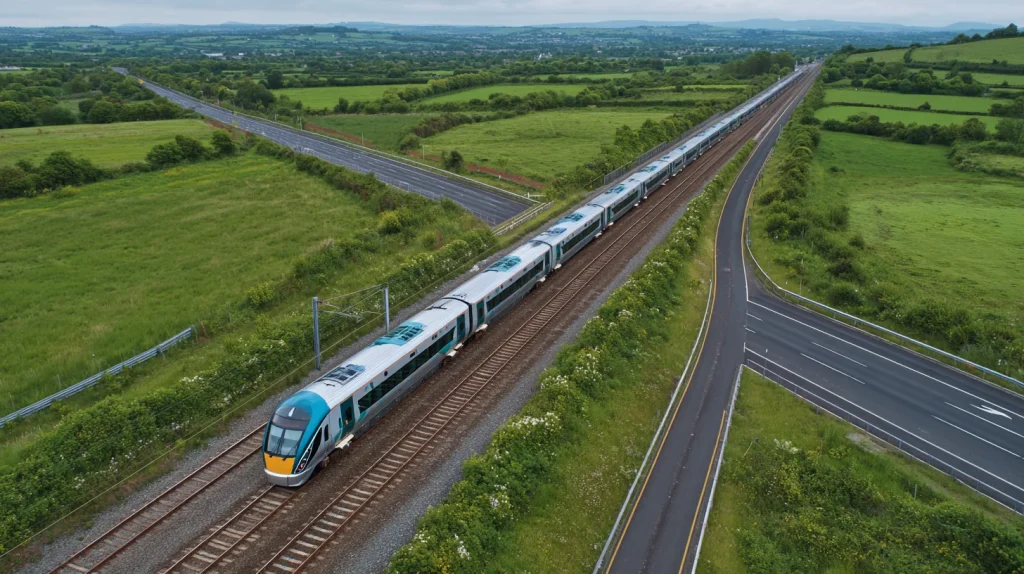
Railway corridors present many of the same challenges as roads, but they can also involve additional access and operational restrictions. Embankments, cuttings, drainage areas, service routes and boundary strips may be difficult to inspect thoroughly, while vegetation management has to be coordinated around an operational transport network.
A knotweed railway corridor issue may therefore involve far more than the visible growth. A project team may need to understand whether suspected knotweed is confined to one accessible patch, whether it is present close to planned engineering works or whether areas that have previously been cleared require further investigation. The timing of the work can also matter because seasonal dieback may make visual identification less reliable during part of the year.
Boundaries create another layer of complexity. Knotweed may be clearly visible outside the railway boundary while planned works are taking place close to it on the operational side. In these cases, simply identifying who owns the visible plants does not necessarily answer the engineering question. Our guide to Japanese knotweed on neighbouring land explains why nearby growth may still need to be considered when excavation or other ground disturbance is planned close to a boundary.
Utility corridors and civil engineering projects
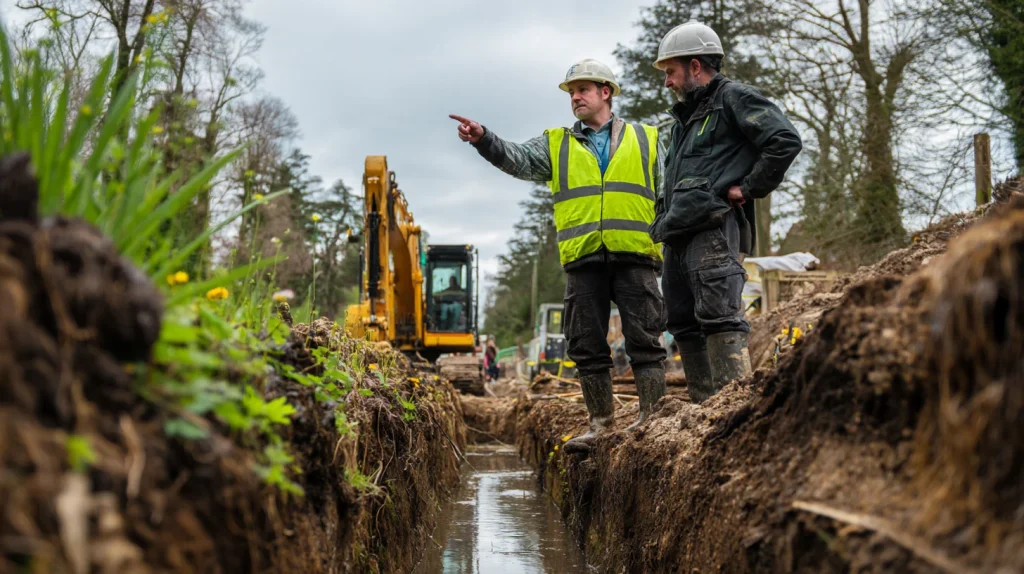
Electricity, water, telecommunications, pipelines and drainage infrastructure can also be vulnerable to Japanese knotweed risk because these projects often involve narrow but highly disturbed working corridors. Trenching, duct installation, pipe replacement and access construction can require excavation through areas that may not have been investigated in detail beforehand.
One section of a utility route may cross managed agricultural land, while the next passes through an old industrial plot, a road verge, a river corridor or an unmanaged boundary. The likelihood of encountering Japanese knotweed is therefore unlikely to be uniform across the entire route. Treating every metre of a long corridor as if it carries the same level of risk can be unnecessarily expensive, while assuming the route is clear because most of it looks unaffected can create the opposite problem.
A more proportionate approach is to identify sections where site history, previous sightings, disturbed ground or adjoining infestations justify closer investigation. CDI’s overview of Japanese knotweed detection explains how specialist detection can support decisions where visible evidence alone does not provide enough certainty.
Why visual inspection may not be enough
Visual inspection remains an important part of Japanese knotweed assessment. During the growing season, established plants can display recognisable features that allow an experienced surveyor to identify obvious infestations relatively quickly. For straightforward sites, this may provide much of the information required. Infrastructure corridors, however, are often not straightforward sites. Vegetation may have been repeatedly cut, the area may contain dense growth from other species, or previous construction may have disturbed the original infestation. In these situations, relying only on what can be seen above ground may leave uncertainty about areas where the plant has previously been present.
Seasonality creates a further challenge. During winter, the fresh stems and leaves disappear while the underground rhizome system remains. Infrastructure projects do not stop simply because the growing season has ended, so planning teams may need answers before spring growth returns. Our guide to Japanese knotweed winter detection explains why specialist investigation can be useful where a project timetable cannot wait for more obvious seasonal growth.
When should an infrastructure knotweed survey take place?
An infrastructure knotweed survey is most valuable when it takes place early enough for the findings to influence the project. For new road, rail or utility schemes, this may mean carrying out investigation during environmental assessment, detailed design or pre-construction planning rather than waiting until excavation has already started. Early information can help project teams define affected zones, adjust access arrangements and plan soil management before contractors mobilise. If only a small number of locations require specific controls, those areas can be incorporated into the programme while unaffected parts of the project continue without unnecessary restrictions.
Further investigation may also become necessary when the project footprint changes. Revised drainage routes, temporary compounds, construction access, service diversions or additional excavation can bring new areas into the working zone. Japanese knotweed risk should therefore be considered in relation to the ground that will actually be disturbed rather than treated as a one-off environmental exercise completed early in the project and then forgotten. Where knotweed is confirmed, survey and treatment should also be treated as separate stages. Our guide comparing a detection survey and treatment plan explains why understanding the extent of the risk should generally come before deciding how confirmed knotweed will be managed.
Soil movement can turn a localised problem into a project-wide issue
Soil movement is one of the main reasons Japanese knotweed deserves particular attention on infrastructure projects. Road construction, railway works and large civil engineering schemes may involve excavation, stockpiling, reuse of material, cut-and-fill operations and movement of soil between different parts of the site. If affected material enters that process without being recognised, the original infestation can potentially be redistributed beyond the location where it was first present. A problem that may initially have been manageable within a small area can then begin to affect additional work zones, stockpiles or disposal decisions.
For project teams, the practical lesson is straightforward. Knotweed risk should ideally be investigated before the major earthworks phase begins. Discovering suspicious material only after an excavator has opened the ground creates a much more difficult situation because site operations may already have disturbed the area or moved material elsewhere. This is one of the strongest commercial reasons for carrying out an infrastructure knotweed survey early. The objective is not only to find the plant but to prevent avoidable uncertainty from entering the soil-management process.
Vegetation clearance should not come before investigation
Vegetation clearance is often one of the first visible stages of a road, railway or development project, but clearing the site before checking for Japanese knotweed can remove some of the most useful identification evidence. If mature stems or other obvious growth are cut down before they have been recorded, the site may subsequently appear cleaner without actually being lower risk. Machinery used for vegetation management can also move between different areas of the project, which makes correct identification before clearance particularly important.
Where there is credible knotweed risk, invasive species assessment should therefore be completed before widespread vegetation removal where practical. If clearance has already occurred, the site should not automatically be assumed clear. Historical information, earlier photographs, neighbouring infestations, remaining canes and specialist detection can all become relevant. This principle is particularly important on redevelopment land where vegetation may have been cleared several times before the current project begins. CDI’s development site knotweed case study demonstrates how previous disturbance can make understanding the true extent of the risk more important before major works proceed.
Managing knotweed across project and property boundaries
Large infrastructure projects rarely sit within a single uncomplicated boundary. Road schemes may cross farms, commercial property and public land, while rail and utility corridors often run directly beside privately owned sites. This can make knotweed discovered outside the immediate project footprint relevant to the construction team. Visible growth on adjoining land does not automatically mean that the project site is affected, but it may justify further investigation where excavation or access will take place close to the infestation. The correct response is therefore not to assume either that the problem stops at the boundary or that the entire adjoining area is contaminated.
Professional investigation can help define the areas where additional controls may be needed. This information can then support communication between the asset owner, contractor, environmental consultant and neighbouring landowner without making unsupported assumptions about the extent of the infestation. For infrastructure managers, this becomes particularly valuable when the project involves multiple ownership boundaries over a long route. Accurate information can prevent the team from applying the same level of restriction to every adjoining property simply because Japanese knotweed has been observed somewhere nearby.
What councils and public-sector asset managers should consider
Councils and public-sector asset managers often face a practical challenge with Japanese knotweed because essential maintenance still needs to continue. Roads, drainage infrastructure and public spaces cannot simply be left untouched indefinitely, but routine works should not inadvertently contribute to the spread of an invasive species. Early identification allows the affected location to be mapped and incorporated into maintenance planning. Contractors responsible for verge cutting, drainage clearance or road improvement works can then be briefed before entering the area rather than discovering the plant during routine operations.
Good records also become increasingly valuable over time. Maintaining information about previous sightings, treatment areas, surveys and confirmed clear zones gives future project teams a much stronger starting point than relying on informal knowledge held by individual members of staff. For authorities responsible for extensive road networks, this can gradually shift knotweed management from a reactive process into a more structured part of infrastructure and environmental risk management.
What contractors should consider before mobilisation
For civil engineering contractors, Japanese knotweed information needs to be practical enough to use on site. A generic note in an environmental report is of limited value if machine operators and site managers do not know which areas require controls or what activities need to be avoided.
Where knotweed risk is identified during tendering or pre-construction planning, it can be incorporated into method statements, soil handling procedures, temporary access planning and project sequencing. Discovering the same issue after mobilisation is much more disruptive because equipment, labour and excavation programmes may already have been committed.
A professional survey can therefore provide value beyond environmental compliance. Clearer information allows the contractor to distinguish between areas requiring additional management and areas where work can proceed normally. This avoids both accidental disturbance and unnecessary restrictions across large sections of unaffected ground. The earlier the project team understands where the risk is located, the easier it becomes to manage the issue proportionately.
How CDI approached a major infrastructure corridor
CDI’s national infrastructure project case study provides a useful example of how Japanese knotweed risk can be approached across a large linear project rather than treating the entire route as a single site. The project involved a major road development corridor crossing different types of land, including roadside areas, previously disturbed ground and locations with different historical uses. Instead of assuming that the same level of knotweed risk applied everywhere, the corridor was assessed according to its individual site characteristics and likely areas of concern.
Professional detection allowed specific areas requiring attention to be separated from much larger parts of the route where the same risk was not identified. This is an important point for councils, transport teams and civil engineering contractors because the value of an infrastructure knotweed survey lies not only in locating Japanese knotweed. It also lies in providing better evidence about where extensive remediation may not be required. For large projects, that distinction can support more proportionate planning, reduce unnecessary intervention and allow resources to be concentrated on confirmed or higher-risk areas.
Why detection dogs can be useful on infrastructure sites
Long infrastructure corridors can be challenging to investigate thoroughly using visual evidence alone. Dense vegetation, previous clearance, seasonal dieback and disturbed soil can all make it difficult to understand whether a suspicious location represents the full extent of the issue.
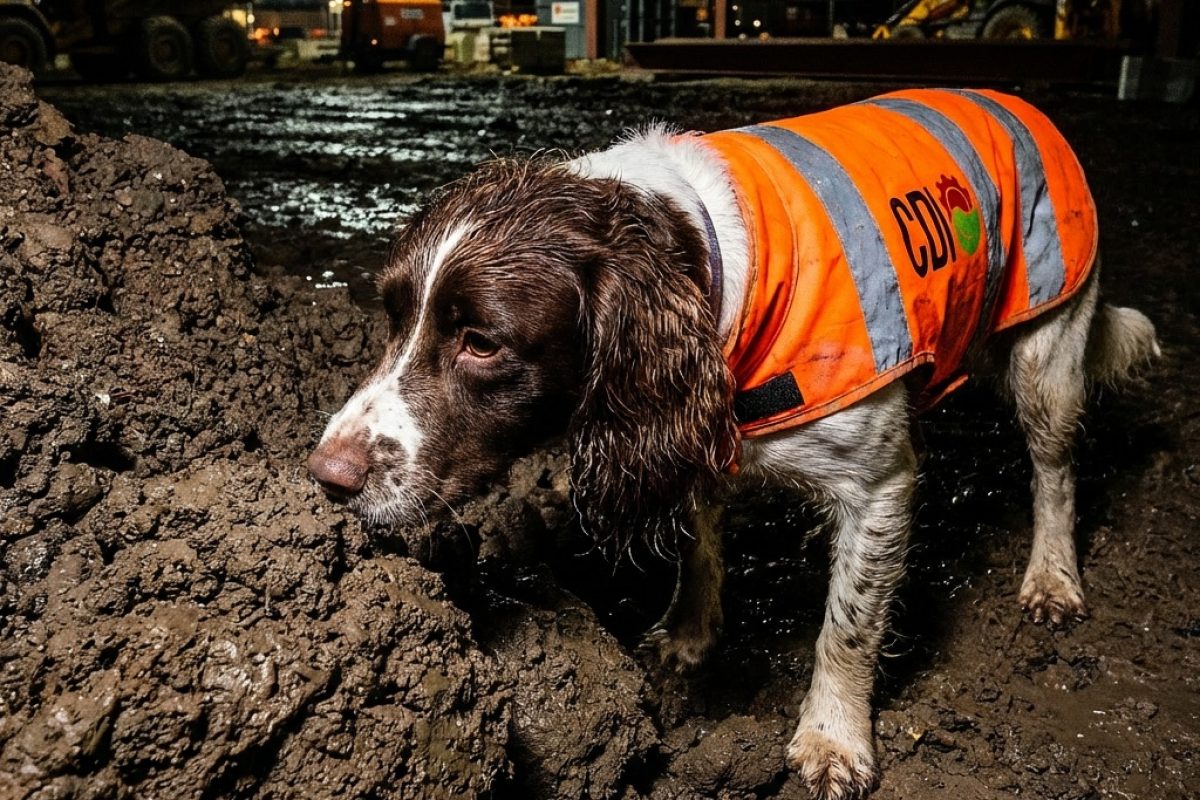
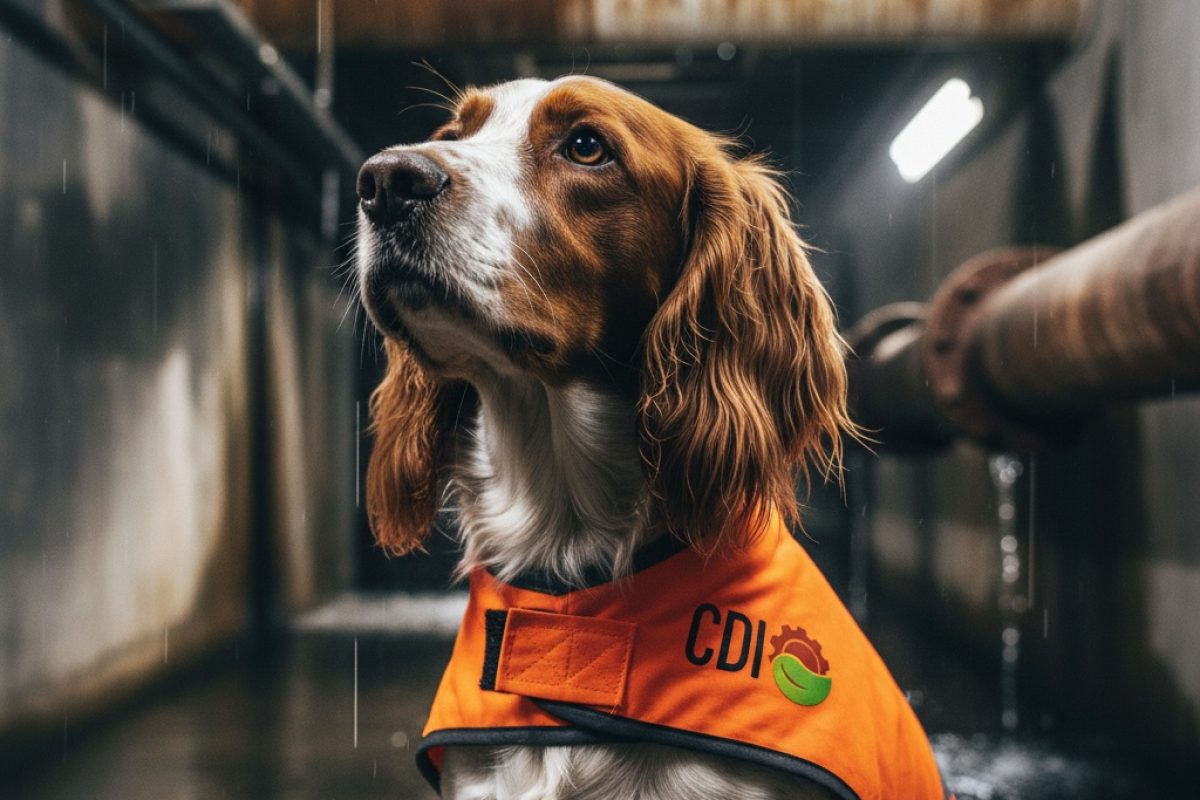
CDI’s Japanese knotweed detection dogs are trained to detect scent associated with Japanese knotweed and can be used in situations involving concealed, dormant or underground material. This can make canine detection particularly useful when an infrastructure project needs information before excavation but visual evidence is incomplete.
The non-invasive nature of detection can also be valuable where unnecessary ground disturbance should be avoided. Rather than excavating simply to investigate whether knotweed may be present, project teams can use detection as part of the wider assessment process before deciding what additional action is justified. For road, rail and utility projects, the ability to investigate targeted sections of a long corridor can make this especially useful where only certain areas present a credible risk.
Reporting a sighting is not the same as surveying an infrastructure corridor
Public reporting of Japanese knotweed sightings can provide useful information about locations where the plant has been observed. However, a recorded sighting and an infrastructure knotweed survey answer very different questions. A sighting confirms that someone has observed suspected or verified Japanese knotweed at a particular location. It does not determine whether the rhizome system extends into the proposed construction footprint, whether previous soil movement has redistributed material or whether other parts of a long corridor are unaffected.
This distinction is especially important on infrastructure projects because both overreaction and underreaction can be costly. Assuming that the entire route is affected because of one sighting may result in unnecessary management, while assuming that the risk is limited exactly to the visible plants may overlook areas that require investigation. Our guide on how to report Japanese knotweed in Ireland explains the purpose of recording a sighting and why reporting should not be confused with a site-specific professional survey.
How CDI supports infrastructure knotweed surveys in Ireland
CDI provides specialist Japanese knotweed detection for infrastructure corridors, road developments, commercial sites and complex construction projects across Ireland. The aim is to help project teams understand where knotweed risk may be present before major decisions about excavation, access, vegetation clearance or soil movement are made. This can include pre-construction corridor surveys, investigation of areas scheduled for excavation, assessments around neighbouring infestations, surveys of previously cleared ground and checks during periods when visual identification is more difficult.
For councils, utility companies, civil engineering contractors and transport teams, the value lies in obtaining information that can be integrated into actual project planning. Instead of simply recording that Japanese knotweed exists somewhere along a route, professional detection can help identify the areas that require specific attention and allow the wider project to be managed more proportionately. Where a road, railway or infrastructure corridor contains known, suspected or historically recorded Japanese knotweed, early investigation provides the project team with more options than waiting until construction is already underway.
Final thoughts
Japanese knotweed on roads, railway corridors and other infrastructure projects in Ireland should be treated as a project-planning and risk-management issue rather than simply unwanted vegetation. Linear schemes combine many of the conditions that can make knotweed difficult to manage, including disturbed ground, repeated maintenance, extensive soil movement, multiple boundaries and long construction footprints.
The most significant problems often arise when Japanese knotweed is discovered too late. Once clearance, excavation or soil movement has already begun, the project team has fewer opportunities to manage the issue without disruption. Investigating credible risk earlier allows affected areas to be considered before they become part of the active earthworks programme.
A professional infrastructure knotweed survey can therefore help determine where further action is required and where unnecessary intervention may be avoided. If Japanese knotweed is known, suspected or historically recorded along a road, railway, utility route or other infrastructure corridor, CDI can carry out a professional Japanese knotweed survey before vegetation clearance, excavation or construction begins.
Frequently asked questions
Is Japanese knotweed common beside roads in Ireland?
Japanese knotweed is often associated with disturbed ground, road verges, development sites and other areas where soil has historically been moved or vegetation management is inconsistent. Roadside sightings should therefore be assessed carefully where maintenance or construction activities are likely to disturb the surrounding ground.
Can Japanese knotweed affect railway corridors?
Yes. Railway embankments, cuttings, boundaries and drainage areas can provide suitable conditions for Japanese knotweed to become established. The main concern arises when the plant is present close to maintenance, engineering or excavation works where affected material could be disturbed.
When should an infrastructure knotweed survey be carried out?
Ideally, an infrastructure knotweed survey should take place before vegetation clearance, excavation or significant soil movement begins. Early investigation gives the project team more opportunity to incorporate any confirmed risk into construction planning rather than responding after work has started.
Can Japanese knotweed spread during road construction?
Japanese knotweed can be spread when viable plant or rhizome material is disturbed and moved into previously unaffected areas. Construction activities involving excavation, soil handling and vegetation clearance therefore require particular care where knotweed is known or suspected.
Can Japanese knotweed be surveyed during winter?
Yes. Although visual identification becomes more difficult when fresh above-ground growth dies back, specialist detection can still be useful where construction or infrastructure planning cannot wait until the following growing season.
Are detection dogs suitable for large infrastructure corridors?
Detection dogs can be particularly useful on large or complex sites where visual assessment alone may leave uncertainty. CDI has used canine detection on major infrastructure projects to investigate priority sections and distinguish confirmed risk areas from larger parts of the corridor where the same evidence was not found.
Is an infrastructure knotweed survey the same as a treatment plan?
No. A survey is intended to identify and define the potential knotweed risk on a site. A treatment or remediation plan deals with how confirmed Japanese knotweed should subsequently be managed. On larger projects, understanding the extent of the issue should generally come before deciding on the appropriate treatment strategy.
Should roadside Japanese knotweed simply be cut down?
No. Suspected Japanese knotweed should not be treated as ordinary roadside vegetation. Cutting, digging or other disturbance may create additional spread risks. The plant should first be identified and the site assessed so that the appropriate management approach can be determined.